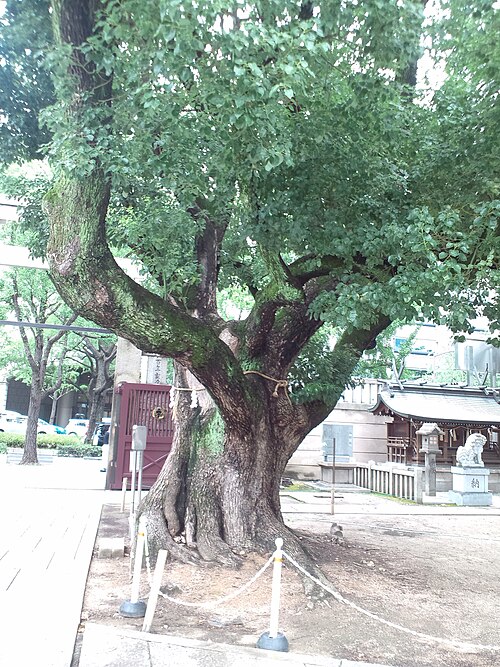
The Thousand-Year Camphor of Nankunsha
Sumiyoshi, Sumiyoshi-ku
Approximate location.
Once a month, on the shrine calendar's first day of the earthly-branch cycle, pilgrims climb the steps to Nankunsha and buy a small ceramic cat. Miss a month and a four-year cycle called hattatsu-mairi starts over: 48 cats, one paw raised for household safety, the other for business luck, collected at the foot of this camphor tree until a full set earns a trade-up to a bigger cat. The custom has made Nankunsha, a small shrine tucked behind Sumiyoshi Taisha's main hall, one of the most visited corners of Osaka's oldest and most revered shrine complex, even though the tree itself predates the ritual by centuries. The Sennen-kusu, literally the Thousand-Year Camphor, has a trunk measuring nearly ten metres around and stands roughly as old as its name claims, a start somewhere around the late Heian period. Osaka City has designated it a preserved tree. Sumiyoshi Taisha's own founding legend reaches back roughly 1,800 years, to Empress Jingu's return from a campaign on the Korean peninsula, and this camphor is one of the oldest living things still standing on ground that has hosted continuous worship since. Visitors rarely come for the tree alone. They come for the cats, then notice, almost as an afterthought, what has been growing over their heads the whole time.
From people who stood here
No notes yet
Did you visit the tree? Leave a note for the next visitor.
Getting there
Nankunsha, Sumiyoshi Taisha, 2-9-89 Sumiyoshi, Sumiyoshi-ku, Osaka 558-0045
You can recognise it by its huge trunk, nearly ten metres round, towering over Nankunsha's cat-collecting pilgrims. It stands behind Sumiyoshi Taisha's main hall, beside its twin-trunked neighbour.
3 min walk from Sumiyoshitaisha Station (Nankai Main Line); Sumiyoshi-Torii-mae tram stop (Hankai Line) is right at the gate
Sources
Where the facts on this page come from. The story was written with AI from these sources, and readers who know the tree correct it.