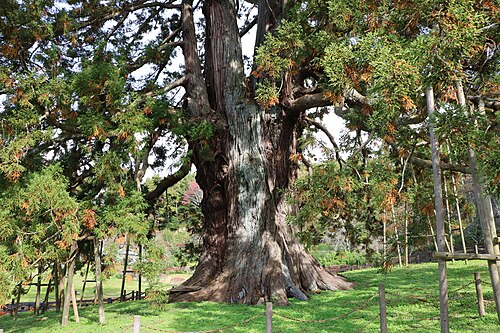
Kohata no O Sugi (Kohata's Great Cedar)
JapanNihonmatsuKohata, Nihonmatsu
Lightning hollowed this cedar from the inside. The cavity has been sealed and more than ten struts now hold the tree upright, which is how a cedar of this size stays standing once its core has gone. It is alive and under constant maintenance, which is not the same thing as untouched. It grows on Mt Kohata inside the precinct of Okitsushima Shrine, on the north side of the small Kado Shrine building. Shrine tradition puts the founding at 769 and dedicates the place to the three Munakata goddesses; for centuries it was known as Benzaiten-gu, and people here still call it Kohata's Benten-sama. The cedar has been a National Natural Monument since March 1941 and ranks as the tenth-largest tree in Fukushima Prefecture. Sources do not agree on its dimensions. Nihonmatsu City records 20 metres tall with a trunk 9.33 metres round at breast height; a Fukushima Prefecture forest survey of 2016 and 2017 makes it 29 metres and 9.9 metres. Both accept the 1940 figure for the root girth, 16.2 metres. Age is given as 780 years by the survey and about 800 by the city, and neither number comes from counting rings. Reaching it is a climb rather than a stroll, up the stone stairway from the first torii. Other large cedars and cypresses stand in the grounds, said locally to have been planted by the daimyo Gamo Ujisato.
Kohata, Haruja 49-2 (also written 治家49-2), Nihonmatsu City, Fukushima Prefecture, within the grounds of Okitsushima Shrine (隠津島神社), on Mt Kohata, beside the subsidiary Kado Shrine (門神社)You can recognise it by the struts bracing its lightning-hollowed trunk, more than ten of them. It stands beside the Kado Shrine, up the stone stairway from Okitsushima Shrine's first torii.
Free, shrine grounds. Reached via the shrine's main approach (omote-sando) off route 117, a stone stairway from the first torii up Mt Kohata; parking (~10 cars) near the approach entrance and ~5 more near the second shrine office. This is a genuine climb, not a flat stroll, but no permission or ticket is needed.
About 20 min by car from Adachi Station, 25 min from Matsukawa Station, 35 min from Nihonmatsu Station (all JR Tohoku Main Line); no direct public transit to the shrine.
Sources
Where the facts on this page come from.