Two of Fukushima's great cedars, each a National Natural Monument in its own right. Kohata's Great Cedar was hollowed out by lightning and now stands on more than ten struts, alive at roughly 780 to 800 years inside Okitsushima Shrine on Mt Kohata. Sugisawa's Great Cedar, further south, runs a trunk 10.9 metres round at close to a thousand years old, the whole village renamed after it in 1643. Both free, both open at all times, both a genuine climb or walk rather than a stroll.
0 of 2 visited in Nihonmatsu
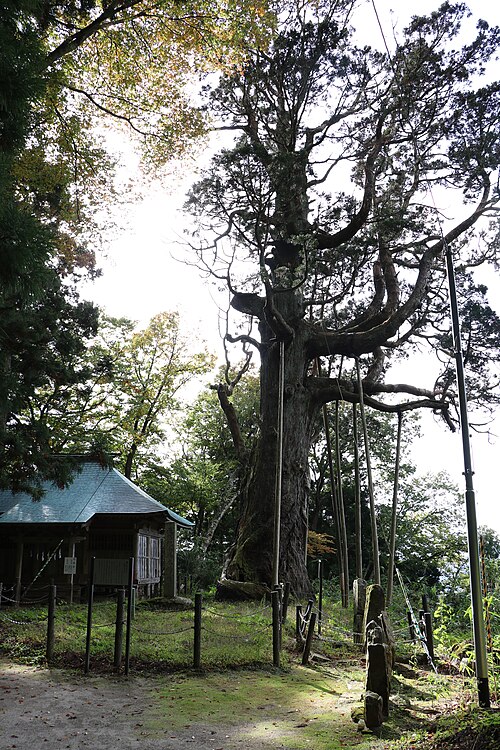
Japanese Cedar (Cryptomeria japonica) · 780-800 years · Kohata, Nihonmatsu
Lightning hollowed this cedar from the inside. The cavity has been sealed and more than ten struts now hold the tree upright, which is how a cedar of this size stays standing once its core has gone. It is alive and under constant maintenance, which is not the same thing as untouched.
It grows on Mt Kohata inside the precinct of Okitsushima Shrine, on the north side of the small Kado Shrine building. Shrine tradition puts the founding at 769 and dedicates the place to the three Munakata goddesses; for centuries it was known as Benzaiten-gu, and people here still call it Kohata's Benten-sama. The cedar has been a National Natural Monument since March 1941 and ranks as the tenth-largest tree in Fukushima Prefecture.
Sources do not agree on its dimensions. Nihonmatsu City records 20 metres tall with a trunk 9.33 metres round at breast height; a Fukushima Prefecture forest survey of 2016 and 2017 makes it 29 metres and 9.9 metres. Both accept the 1940 figure for the root girth, 16.2 metres. Age is given as 780 years by the survey and about 800 by the city, and neither number comes from counting rings.
Reaching it is a climb rather than a stroll, up the stone stairway from the first torii. Other large cedars and cypresses stand in the grounds, said locally to have been planted by the daimyo Gamo Ujisato.
Photo: さかおり (CC BY-SA 4.0)
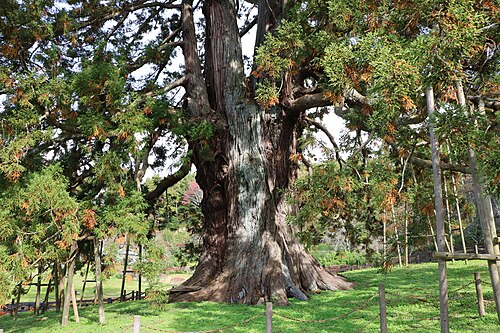
Japanese Cedar (Cryptomeria japonica) · 1,000 years · Sugisawa, Nihonmatsu
In 1643 the lord of the Nihonmatsu domain, Niwa Mitsushige, stopped under this cedar on an inspection tour and, by local account, was struck enough by it to rename the village Sugisawa after the tree. The name has stuck for close to four hundred years.
It has been a National Natural Monument since August 1943 and a Fukushima Green Cultural Property since 1983, and of the great cedars of this prefecture it is the one in the best condition: vitality described as vigorous, and remarkably little decay in the trunk for a tree of its age. That has not happened on its own. The cavity was treated, the roots reinforced and supports fitted in 1986 and 1987; between 2006 and 2008 the soil over the root plate was improved and visitors were kept off it.
Its size is genuinely hard to pin down, because the trunk divides into five main stems from about 6.6 metres up and the crown spreads 25 to 30 metres across. Nihonmatsu City records a girth of 12.8 metres; the standard breast-height measurement is 10.9 metres, and the root girth 22.5 metres. Height is given as 50 metres, with one source stretching that to 68, which is tall enough for a sugi to be worth treating carefully.
The age usually quoted is around a thousand years, and one source allows for considerably less. Nobody has counted the rings.
Photo: さかおり (CC BY 4.0)