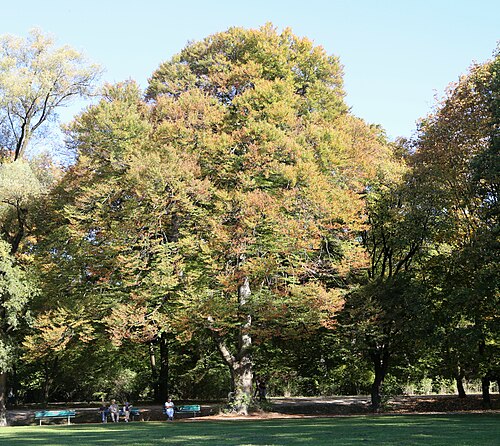
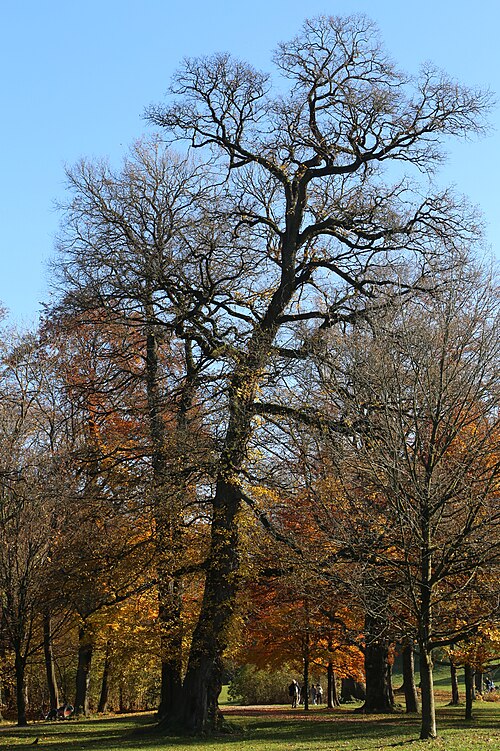
For centuries in this part of Europe, a village's justice was handed down under a lime. The Gerichtslinde, the court lime, was a real institution: a broad tree on the square with benches beneath it, where the local court sat in the open because everybody could then see and hear what had been decided. Small-leaved lime was usually the tree chosen, because it lives long, takes heavy pruning and builds exactly that kind of wide, shading crown. Munich protects this one for its trunk, which the ordinance describes as having rarity value in the city on account of its form and its girth. It stands on open ground in the Englischer Garten. That girth is never given a number. The city's list says why a tree is protected and stops there, so the trunk that earned this tree its protection has no published measurement and no date beside it. Small-leaved lime flowers later than any other European lime, in late June and July, once most of the summer's blossom is over. The flowers themselves are small, greenish and easy to walk past. You will not walk past the sound, because the whole crown fills with bees, and the scent reaches you a good twenty metres before the tree does.
In bloom
late June into July, when it flowers late for a lime and the crown fills with bees
The line is our estimate of how much there is to see, not a measurement. Typical for this species where this tree stands; exact weeks shift with the year.
You can recognise it by a wide, heavily pruned crown built for shade, the type of lime once used as a village court tree, standing on open ground. It stands in the Englischer Garten.
Sources
Where the facts on this page come from.
- In the official register: Naturdenkmal (Bayern LfU), no. ND-01993
- lfu.bayern.de