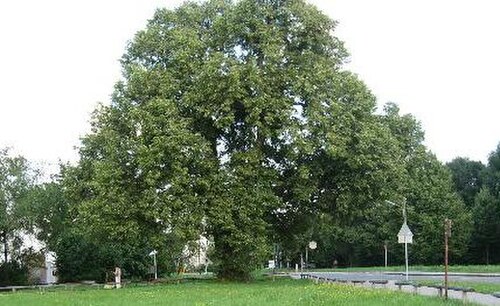
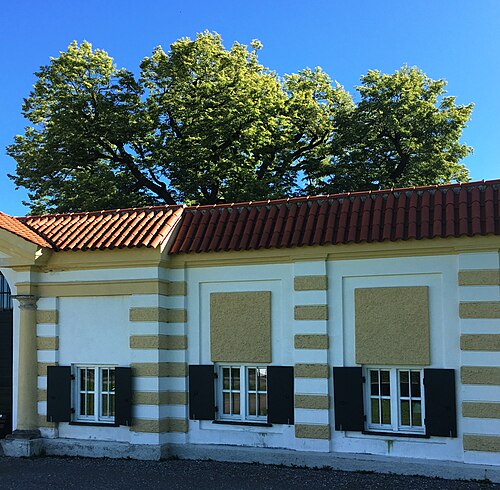
Munich's protection order calls this tree rare, which is an odd thing to say about a red oak. The species is everywhere in European parks: brought over from eastern North America in the eighteenth century for fast timber and for the autumn colour, and planted by the thousand ever since. What is rare is one allowed to reach full size inside a city. The ordinance says so in five words of German that translate as a very large red oak, rare within the city, and leaves it there. It stands in Hartmannshofer Park in Moosach, in Munich's north-west, on ground that was estate land before the city reached it. Red oak leaves are the giveaway: big, thin, with bristle tips on each lobe, nothing like the round-lobed native oaks, and in autumn the whole crown goes scarlet rather than the brown that a pedunculate oak settles for. The bark stays smooth and grey far longer than a European oak's, which is another way to be sure you are standing at the right trunk. No age is recorded anywhere. Red oaks grow fast, so size is a poor guide here, and guessing would be worse than admitting it. If you know when this one was planted, tell us.
Autumn colour
late October into November, when the crown turns scarlet
The line is our estimate of how much there is to see, not a measurement. Typical for this species where this tree stands; exact weeks shift with the year.
Hartmannshofer Park, 80993 MünchenYou can recognise it by the leaves, each lobe ending in a bristle where Munich's native oaks are round, and by the bark, smooth and grey far longer than theirs. It stands in Hartmannshofer Park in Moosach.
Free, public land, no restrictions
In Moosach's Hartmannshofer Park
Sources
Where the facts on this page come from.
- In the official register: Naturdenkmal (Bayern LfU), no. ND-07039
- Munich Naturdenkmalverordnung 2021, Moosach 4
- lfu.bayern.de