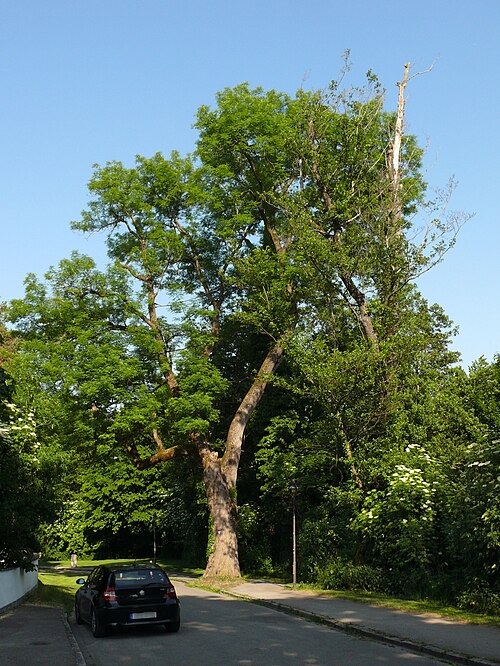
Maria-Eich-Strasse means Mary's Oak Street, and this is not that oak. The name belongs to the pilgrimage site at Planegg, out beyond the city boundary at the far end of the road, where by tradition a figure of the Virgin was set into a hollow oak in the early eighteenth century and a chapel grew up around the spot. Whether the street was named for that tree or simply for the place it leads to, the oak standing on it in Obermenzing today is a separate tree with a separate life, and the city protects it on its own account: a dominant tree that shapes the townscape, in the words of Munich's 2021 natural monument ordinance. Obermenzing is the green, villa-and-garden neighbour of Pasing in Munich's west, and a pedunculate oak here is a native on home ground rather than an import. Quercus robur is the species that carried central Europe: pigs were driven out to fatten on its acorns, ships and roof beams came out of its timber, and a single mature one supports more insect species than almost any other tree here. The register gives no age and no girth for it. Oaks reward a tape measure more than most. If you bring one, tell us what you find.
In fruit
September to October: acorns drop, and a good mast year buries the ground in them
The line is our estimate of how much there is to see, not a measurement. Typical for this species where this tree stands; exact weeks shift with the year.
Maria-Eich-Straße 119, 81241 MünchenYou can recognise it by its size, the one tree on the street big enough to shape the view down it. It stands on Maria-Eich-Straße in Obermenzing, which is named for the pilgrimage oak at Planegg and not for this one.
Free, public land, no restrictions
In Obermenzing, on Maria-Eich-Straße
Sources
Where the facts on this page come from.
- In the official register: Naturdenkmal (Bayern LfU), no. ND-07051
- Munich Naturdenkmalverordnung 2021, Pasing-Obermenzing 3
- lfu.bayern.de