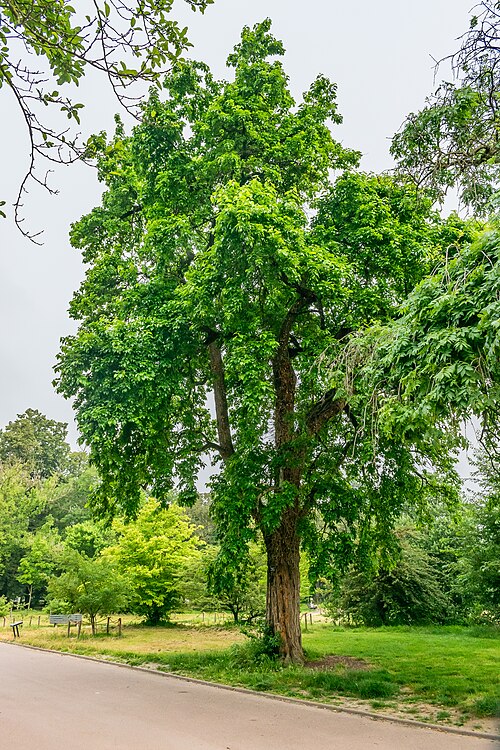
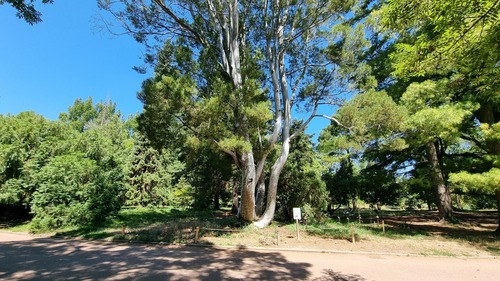
This maple comes from a stretch of the world most visitors to a French municipal park have never had reason to think about: the mountain forests running from the Caucasus through northern Iran and on toward the Himalayas, where Acer cappadocicum grows wild among beech and oak. Lyon's botanical garden, folded into the Tête d'Or since 1857, was built to hold exactly this kind of geographic range, species chosen for scientific and educational value as much as for looks. A dendrological survey of the park recorded this specimen's girth at 3.20 metres a metre above ground and its height at 26 metres, respectable rather than record-breaking figures next to the arboretum's largest specimens, but enough to mark it as a genuinely mature, long-established tree rather than a recent planting. No individual planting date is documented, so its age is estimated here from its measured size and the arboretum's own founding period rather than a verified record. In autumn its leaves turn a clean, even yellow, a display Cappadocian maples are specifically valued for in cultivation, though no source dates this specimen's colour peak precisely enough to state a reliable calendar window here.
From people who stood here
No notes yet
Did you visit the tree? Leave a note for the next visitor.
Getting there
Parc de la Tête d'Or, arboretum, 69006 Lyon
You can recognise it by its clean, even yellow autumn colour and a trunk about 3.20 metres round, 26 metres tall. It stands in the arboretum of Parc de la Tete d'Or.
10 min walk from Masséna metro station (Line A)
Autumn colour
October into November, when its leaves turn a rich butter yellow
Sources
Where the facts on this page come from. The story was written with AI from these sources, and readers who know the tree correct it.