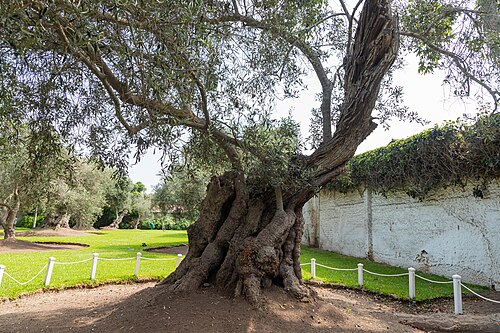
Strictly speaking this is not a tree. An ombu has no true wood: the swollen grey column holding up the crown is soft tissue full of stored water, which is how the species gets through drought on the South American grasslands where it belongs. It is a giant herb, roughly 25 to 30 metres of it, depending on whose measurement you take. The story attached to it is Peru's founding one. In 1821, the year independence was declared, Jose de San Martin was living at the Quinta de los Libertadores in Pueblo Libre, and the ombu went into the garden from a seed he is said to have carried up from Argentina. Every Peruvian retelling credits the liberator's own hands, and the outlets that repeat it also file that part as legend, so we will too. The date is the part that holds. San Martin handed the war to Bolivar and left the country the following year. The ombu stayed and watched the republic assemble itself around the house, which is now a museum, in a garden that is now the public Parque El Carmen. Pueblo Libre declared it Registro 1, cultural and historical heritage of the district, in 2020, and rebuilt the ground around it in 2022 with new lighting and a pergola. Two hundred years, and still no wood in it.
Parque El Carmen (Quinta de los Libertadores), Pueblo LibreYou can recognise it by its swollen grey trunk, soft rather than woody, holding up a crown some 25 to 30 metres across. It stands in Parque El Carmen, in Pueblo Libre.
Free, in Parque El Carmen, a public park
Central Pueblo Libre, walkable from Plaza Bolivar
Sources
Where the facts on this page come from.