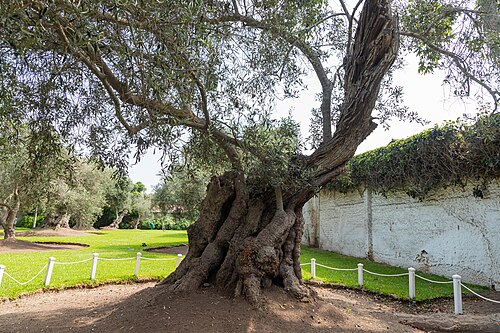
This is a rainforest tree standing in a desert. The kapok belongs to tropical lowland forest, where it pushes its crown out above the canopy on buttress roots wide enough to stand between. Lima is a desert city whose nearest thing to weather is months of grey sea fog. San Isidro's own heritage route calls the ceibo an uncommon sight in this part of the city, and there are two of them in the district, this one and another on Calle Alfredo Roldan Seminario. It grows in the green strip at the entrance to Parque Ernesto Alayza Grundy on Calle Victor Maurtua, and it was one of three trees San Isidro recognised together in Ordinance 535-MSI, published in February 2021. The other two stand in the Bosque El Olivar a short walk north, an olive close to 390 years old and a 40-metre araucaria. This one is Registro 002-2020-MSI. In June 2026 all three became stops on the district's heritage tree route. Ceibas flower at night and are pollinated by bats. Then they hang out pods of silky floss, the kapok that once stuffed mattresses and life jackets, which comes apart and drifts across whatever is underneath. No age has been published for it, and no height or girth either. If you have measured it, or know when it was planted, tell us.
Green area of Pasaje 65 NN, at the entrance to Parque Ernesto Alayza Grundy, Calle Victor Maurtua (block 1), San IsidroYou can recognise it by its wide buttress roots and tropical crown, unlike anything else in this desert city. It stands in the green entrance strip of Parque Ernesto Alayza Grundy.
Free, in the entrance green area of a public park
San Isidro, walkable within the district
Sources
Where the facts on this page come from.