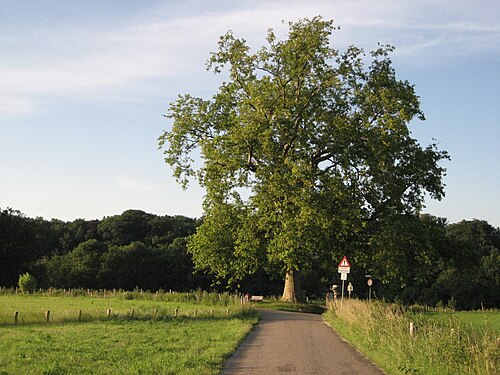
A second oak from the same wider stretch of woodland as its neighbour at Imstenrade, this one growing at the edge of the trees on the north side of Nieuw Eyckholt. The register bands its planting to 1850-1860, putting it at roughly 170 years, a generation or two younger than the Imstenrade oak and considerably more precisely dated. Eyckholt takes its name from the ruined medieval castle whose stronghold still stands nearby, first built around 1300 on the wooded slope above the Geleen valley. By the 1850s the ground around it had long since settled into ordinary estate woodland, and an oak planted at a forest edge in that decade would have grown up with room on one side and competition from other trees on the other, a lopsided crown often being the visible result. Nothing beyond the register describes this tree specifically: no plaque, no local story, just a species, a decade and a place. That is not unusual for a woodland-edge planting rather than one that stood beside a house or a road where people were more likely to notice it and remember why it went in. If you know more about this oak, tell us.
In fruit
September to October: acorns drop, and a good mast year buries the ground in them
The line is our estimate of how much there is to see, not a measurement. Typical for this species where this tree stands; exact weeks shift with the year.
Heerlen, Nieuw Eyckholt, aan bosrand ten noorden van de wegYou can recognise it by its lopsided crown, open on the side that faced the forest edge and crowded on the other. It stands at the edge of the trees north of Nieuw Eyckholt.
Free, public planting, always open.
Sources
Where the facts on this page come from.
- In the official register: Landelijk Register Monumentale Bomen (Bomenstichting), no. 1695310
- monumentalebomen.nl
- services-eu1.arcgis.com