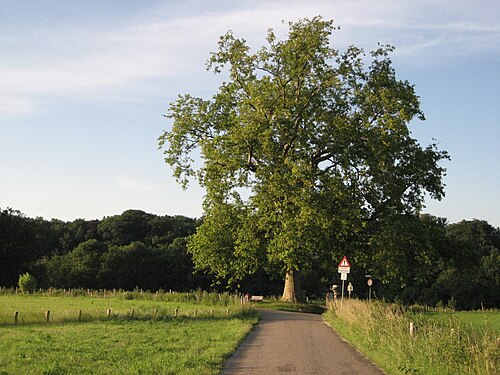
This ginkgo grows along the drive to Kasteel Terworm, in good health as of a 2026 survey, standing where anyone walking up to the castle's front door can see it. The register bands its planting to 1910-1920, roughly a century, and offers two guesses rather than one: either it went in during an 1890s renovation under Baron de Loë, or during the few years around 1902 to 1907 when the estate was let to a mining baron named Wenckenbach, whose industry was reshaping the whole Heerlen region at the time. Terworm's own history runs back to around 1400 and a family named Van der Worm, through at least six rebuildings to the house that stands today, a period as an open-air swimming pool in its lower pond during the 1930s, and a near miss with becoming a theme park that Heerlen's own residents blocked. It is a hotel now, and the wooded estate around it belongs to Natuurmonumenten, a conservation organisation, which is why the grounds stay open to walkers rather than becoming private again. A ginkgo this size beside an old yew planting makes the drive up to the castle one of the more photogenic approaches in the register. If you know which decade it actually went in, tell us.
Autumn colour
November: the whole crown turns butter gold, then drops in a day or two
The line is our estimate of how much there is to see, not a measurement. Typical for this species where this tree stands; exact weeks shift with the year.
Terworm 5D, 6411 RV HeerlenYou can recognise it by standing beside the drive up to Kasteel Terworm, visible to anyone approaching the front door, near an old yew. It stands at Terworm 5D.
Free, roadside tree on public land, always visible.
Sources
Where the facts on this page come from.
- In the official register: Landelijk Register Monumentale Bomen (Bomenstichting), no. 1697332
- monumentalebomen.nl
- Landelijk Register Monumentale Bomen v2024 (LRMB), Bomenstichting, no. 1697332