Seasons0 of 4
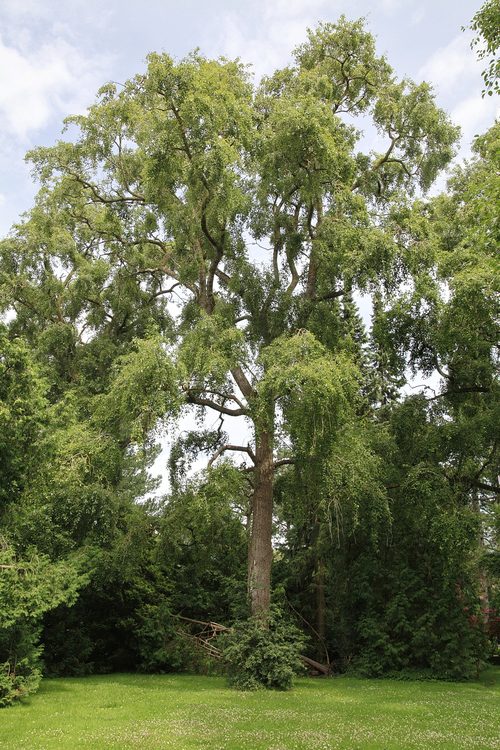
This oak is a long way from home. Quercus frainetto grows wild in southeastern Europe, in the Balkans and down into southern Italy, so nothing about it is a Danish survivor: somebody planted it here on purpose, and it has done well enough to reach 4.19 metres round and 23.5 metres tall. The register describes it as free-standing and full-crowned, which in a cemetery means it has had the space and the light to build the shape it wanted, without competition on any side. It stands about 90 metres northwest of Nordre Kapel at Bispebjerg Kirkegård, where the city planted whole avenues of poplar, pine, ash, hornbeam and Japanese cherry and ended up with something closer to a collection than a churchyard. The leaves settle the identification on the spot. Hungarian oak carries the largest leaves of any European oak, deeply cut into many lobes and crowded toward the ends of the shoots, so the crown looks heavier and darker than a Danish oak's from a distance. Only the register names the tree. The city's cemetery page confirms the avenues and the public access and says nothing about this individual, and nobody has dated it, so no age is offered here.
From people who stood here
No notes yet
Did you visit the tree? Leave a note for the next visitor.
Getting there
Bispebjerg Kirkegard, about 90 metres northwest of Nordre Kapel
You can recognise it by the leaves, much larger than a Danish oak's and cut into many lobes, crowded at the shoot tips, on a free-standing trunk 4.19 metres round. It stands about 90 metres northwest of Nordre Kapel.
Free, the cemetery is open to the public in daylight hours.
Norrebro station (S-train), about 20 minutes on foot, or bus 6A/350S to the cemetery gate on Frederikssundsvej.
Autumn colour
late October, when the cemetery's Hungarian oak turns russet and yellow
The line is our estimate of how much there is to see, not a measurement. Typical for this species where this tree stands; exact weeks shift with the year.
Sources
Where the facts on this page come from. The story was written with AI from these sources, and readers who know the tree correct it.
- In the official register: Dansk Trærregister (Dendrologisk Forening)
- Dansk Traeregister, id 940, position verified 05-07-2017: https://www.dendron.dk/dtr/detaljer.asp?Individual_id=940
- Kobenhavns Kommune's own page on Bispebjerg Kirkegard, confirming public access and the cemetery's varied tree avenues: https://www.kk.dk/brug-byen…
- dendron.dk