Catania's four monumental trees sit within a few minutes of each other on Via Etnea. Villa Bellini, the city's main public garden, holds a fig with a trunk fourteen metres round and a pair of individually registered bunya pines from Australia, all three free to see any day of the year. A short walk further up Via Etnea, a dragon tree from the Canary Islands stands behind the ticket desk of the university's botanical garden, sharing its staircase with a second, unregistered dragon tree.
0 of 4 visited in Catania
Moreton Bay Fig (Ficus macrophylla) · 165 years · Centro Storico
Fourteen metres around the trunk, and a crown that reaches forty-three metres across. On the figures published by Italy's tree registers, only one Moreton Bay fig in Sicily is bigger, the giant in Palermo's botanical garden. What stops people in Villa Bellini, though, is at ground level. A Ficus macrophylla drops aerial roots from its branches and thickens them into buttresses once they reach soil, and this one has thrown a long, coiling sprawl of them out across the ground, the kind of shape that has people reaching for octopus tentacles to describe it.
Its age is genuinely unsettled. One contributor account gives a planting date of 1860, which would make it about 165 years old and would have put it in the ground the year before Italy became a single country. The Italian registry that measured it most recently states an age of around 146. The two do not reconcile, neither has been withdrawn, so both are here.
The recent record is firmer. A 2026 assessment rates its health as adequate rather than good, and the bark carries graffiti and paint from visitors who could not keep their hands off it. Walk under it, walk around it, leave it alone. It stands in Catania's main public park on Via Etnea, free and open daily.
Bunya Pine (Araucaria bidwillii) · Centro Storico
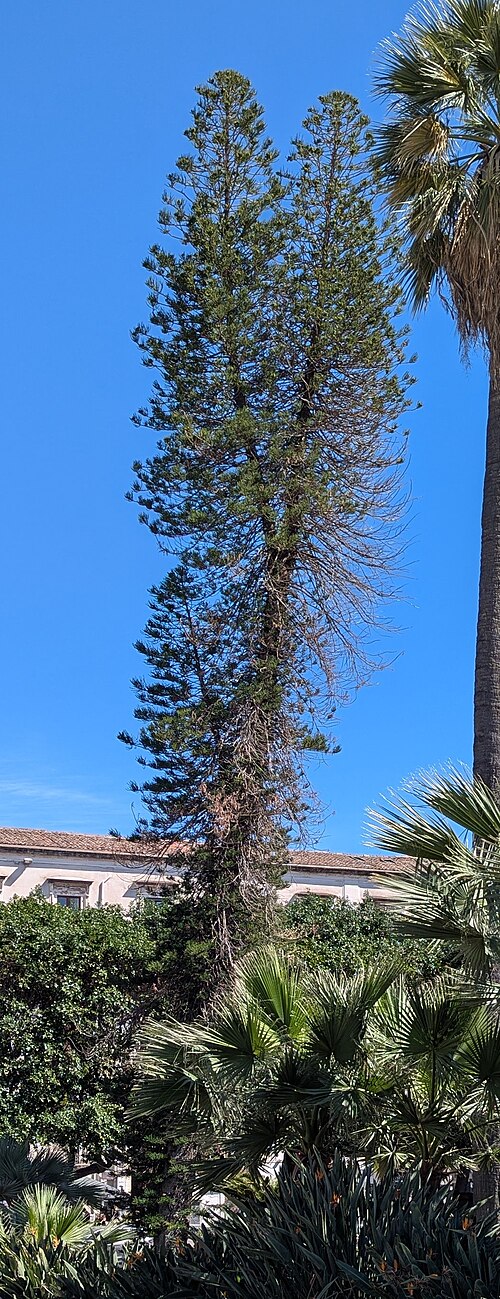
Italy's national register of monumental trees records this bunya pine at 45 metres tall. That figure does not hold up. A second registry measured the same specimen at about 22 metres, and 45 would be remarkable for an Araucaria bidwillii growing anywhere outside its native forest. The trunk is the steadier number, 3.00 metres around on the national sheet against 3.33 on the other, close enough given the years between the two surveys.
The species grows wild in a few pockets of southeast Queensland and nowhere else on earth. It builds a dark, symmetrical dome on a straight column of a trunk, carries stiff glossy leaves in spirals along the branches, and drops cones weighing several kilograms from the top of the crown, which is why Australian parks sign the ground underneath them.
Villa Bellini holds a whole collection of araucarias, the Norfolk Island pine, the Cook pine and the hoop pine among them, but only two are individually listed as monumental: this one and its neighbour, twenty to thirty metres away across the garden. From the path they read as a pair, and there is no reason to see them as anything else. No source records an age for either. Nobody wrote the planting down, and the two registries that took the trunks in hand did not attempt a figure.
Photo: Ivan Ruggiero (CC BY-SA 4.0)
Bunya Pine (Araucaria bidwillii) · Centro Storico
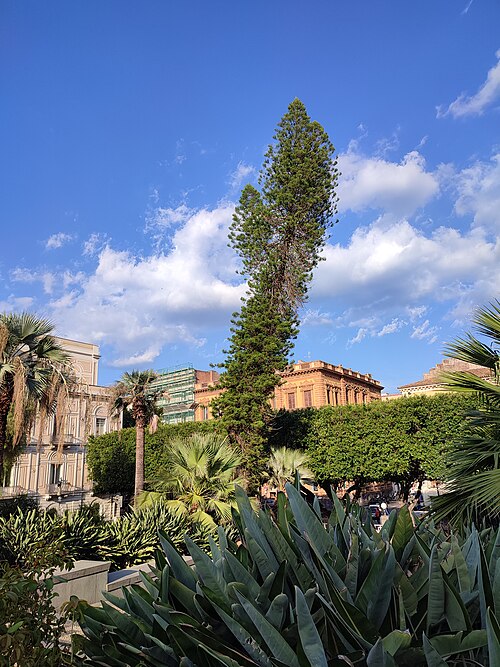
Forty centimetres of trunk is the whole difference between this bunya pine and the one standing twenty to thirty metres away. Italy's national register lists them as two separate monuments, at 3.00 and 3.40 metres around, and a second registry re-measured them at 3.05 and 3.33. On height the difference more or less vanishes and may even run the other way: this one comes out at roughly 22.5 metres against its neighbour's 22, a gap nobody would pick out from the path. The national register puts this tree at 40 metres, which the independent measurement does not support and which reads as an error on the sheet, the same kind that inflates its neighbour to 45.
Araucaria bidwillii is native to a small stretch of southeast Queensland, and in a Sicilian garden it does what it does at home: a straight bare column carrying a dark tiered crown, with leaves stiff and sharp enough to be worth not grabbing.
Neither tree has a documented age. No planting record survives and neither register carries a figure, so what a visitor gets is size rather than years. The two stand close enough that they are one stop on a walk through Villa Bellini, which is the honest way to see them: side by side, forty centimetres apart in the paperwork and near enough identical in person.
Photo: Alacoolwiki (CC BY-SA 4.0)
Dragon Tree (Dracaena draco) · Via Etnea
Two dragon trees flank the marble staircase of the botanical garden's neoclassical building. Italy's national register of monumental trees lists one of them, two metres round, and does not say which. Both are visible from the foot of the steps, so the question settles itself in person.
Dracaena draco is endemic to the Canary Islands and native nowhere near Sicily, and it looks the part: a pale grey trunk that forks, then forks again, into a flat crown of rosettes, each one a burst of stiff blue-green blades. The forking is how it grows. The stem divides only after it flowers, and it flowers at intervals of many years, which is also the reason nobody can tell you how old this tree is. A dragon tree lays down no annual rings, so the usual method simply does not apply, and no source has published an age for the Catania specimen.
The name is not decoration. Its sap oxidises dark red, and was sold across Europe for centuries as dragon's blood, used in varnish, dye and medicine.
Unlike the three Villa Bellini trees a few minutes down Via Etnea, this one sits behind a ticket desk in the University of Catania's botanical garden: three euros, two reduced, weekdays until seven and Saturday mornings, closed Sundays.