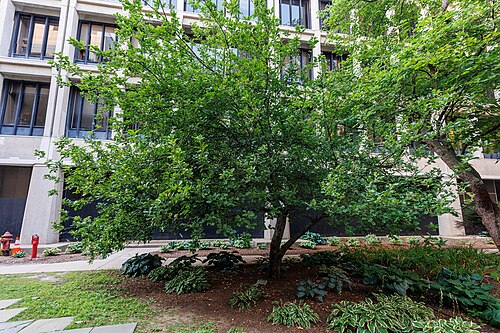
The Longfellow Linden
Cambridge
In the summer of 1844 Henry Wadsworth Longfellow came home to find that workmen had "lopped away the long low branches of my Linden tree, misunderstanding my directions", and he wrote it up in his journal as a small catastrophe. The tree outlived him. It went into the ground around 1800 to 1810, planted by Andrew Craigie, who owned the Brattle Street estate before the poet came to it in 1843, and it stands on the East Lawn of a house that had served as George Washington's headquarters during the siege of Boston a generation before the linden existed. Fanny Longfellow wrote in 1843 of wanting "a linden avenue in which my poet intends to pace in his old age". This is the only tree of that avenue still standing. By 1846 he was describing her reading Heine underneath it. The National Park Service puts it at 82 feet, against roughly 60 for the species, with a trunk 84 inches through, and rates its condition fair to poor: the trunk cavity is filled, cables carry the branches, heavy pruning comes round every five years. Since the early 2000s the park has been growing a genetically identical cutting against the day it goes. The grounds are free and open in daylight; only the house tours are ticketed.
From people who stood here
No notes yet
Did you visit the tree? Leave a note for the next visitor.
Getting there
Longfellow House-Washington's Headquarters National Historic Site, 105 Brattle Street, Cambridge, MA
You can recognise it by the cables carrying its branches and the filled cavity in a trunk 84 inches through, on a linden 82 feet tall where the species usually stops at 60. It stands alone on the East Lawn, the last of its avenue.
Free. The grounds are open daily from dawn to dusk; house tours are separately ticketed, but the East Lawn beside the house, where the linden stands, is part of the grounds.
MBTA Red Line to Harvard Square, then about 8-10 minutes on foot down Brattle Street
In bloom
late June into July, when the lime flowers and the whole East Lawn smells of it
The line is our estimate of how much there is to see, not a measurement. Typical for this species where this tree stands; exact weeks shift with the year.
Sources
Where the facts on this page come from. The story was written with AI from these sources, and readers who know the tree correct it.