Bošáca has produced three of Slovakia's national tree champions from one stretch of countryside. An heirloom apple, about 130 years old, won in 2017 and placed sixth in Europe; a rare pink-fleshed pear, roughly 200 years old, won in 2015 and placed third; and a wild pear on nearby Lysica Hill, about 150 years old, won in 2024 and placed fifth. The apple and older pear stand 350 metres apart in the hamlet of Zabudišová; the wild pear stands four kilometres off. No other Slovak village has produced three champions.
0 of 3 visited in Bošáca
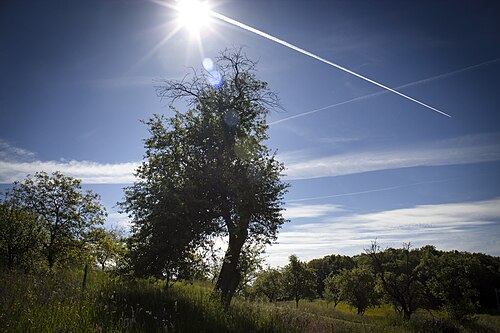
Apple (Malus domestica 'Citrónové zimné Zabudišovské') · 130 years · Zabudišová, Bošáca
In 2017 a nearly forgotten apple variety beat every other tree in Slovakia to become that year's national Tree of the Year, then went on to place sixth in the European final the following spring.
Nobody had paid the tree much attention before the contest. It grows on a roadside in Zabudišová, a scattered hamlet of the village of Bošáca, and belongs to Citrónové zimné Zabudišovské, a lemon-yellow winter apple bred locally and grown almost nowhere else. Itinerant fruit-growers, tradesmen who planted orchards for a living and moved on, are thought to have put it in the ground roughly 130 years ago. When it won, it measured two and a half metres round and stood thirteen metres tall, dimensions that make sense for an apple tree left alone for well over a century.
It still fruits. The variety's practical value, a fruit that keeps through winter without a cellar, is presumably why somebody planted it here in the first place, long before there was a competition to win.
Three hundred and fifty metres away, on the same hillside, stands another Slovak Tree of the Year: a pink-fleshed pear that won two years earlier. Two national champions from one small stretch of Zabudišová, which almost nobody outside Bošáca seems to know.
Photo: Martin Babarik (CC BY-SA 4.0)
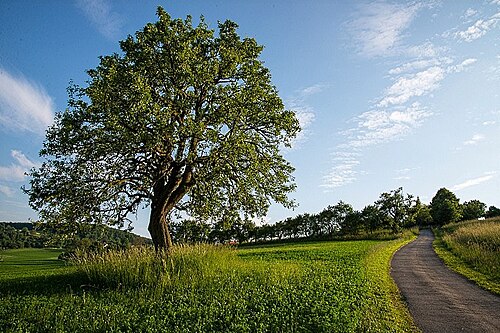
European Pear (Pyrus communis 'Bošácka ružová') · 200 years · Zabudišová, Bošáca
Slovakia's national tree contest has been won only once by a pear, and this pink-fleshed local variety is it.
Bošácka ružová grows almost nowhere outside this stretch of the Bošáca countryside: a pear whose flesh runs pink rather than white, a curiosity local orchardists have kept going for generations. In 2015 it won the national Strom roka title, then went to the European final and placed third, an unusually strong result for a tree nobody outside its own region had heard of a year earlier.
Local tradition holds that it was planted by the area's first settlers, known for making fruit brandy from orchards like this one, though nothing pins that to a date. Two separate outlets covering its 2015 win, pravda.sk and teraz.sk, independently give its age as about two hundred years, which this page repeats with confidence. Nobody has published a reliable girth or height for this specific tree, so those stay open. What is confirmed, from the region's own tourism writing, is a solitary tree on open land near Zabudišová, unfenced and reachable without asking anyone.
It stands 350 metres from another national champion, an heirloom apple that won two years later. Two prize-winning fruit trees, in one small corner of western Slovakia, planted for eating rather than for looking at. If you have measured its girth, tell us.
Photo: Alena Hroncová (CC BY-SA 4.0)
Wild Pear (Pyrus pyraster) · 150 years · Lysica Hill, Bošáca
Nobody planted Bošáca's third champion tree. A bird did, or the wind: a seed from a cultivated pear somewhere nearby landed on the sunny slope of Lysica Hill and took root on its own. Roughly 150 years later it is a wild pear ten metres tall, with a trunk 195 centimetres round.
That sets it apart from its two famous neighbours in Zabudišová, four kilometres away. The pink pear and the heirloom apple there were planted for their fruit. This one is Pyrus pyraster, the wild species, and big self-seeded pears like it are part of what the White Carpathian landscape around the Bošácka valley looks like: a valley that grew fruit for generations, scattering its own trees across the hills.
On Lysica it has become a landmark for the paragliders and model-aircraft flyers who use the hill. In 2024 the municipality nominated it for Slovakia's Tree of the Year, and it won with 2,298 votes, the village's third national title after the pear in 2015 and the apple in 2017. At the European final in 2025 it placed fifth, with 23,729 votes.
The contest's own account and an independent Slovak news report both give its age as 150 years.