Only one of Belfast's oldest trees is an oak, and nobody has settled which oak it is. The Belvoir Oak, in a forest park in the south, is called the oldest living oak in Ireland by the department that manages the ground, though two veterans stand near the Motte and sources disagree about which carries the name. In the Botanic Gardens an Australian grass tree over 400 years old has lived under glass since Victoria's reign, beside a dawn redwood from the year the species came back from the fossil record. The fourth is a hawthorn that named a graveyard.
0 of 5 visited in Belfast
Oak (Quercus sp.) · 400-600 years · Belvoir / Galwally, south Belfast
In the winter of 2016 a ranger counted the acorns on this oak. There were six, and he called that remarkable, because the tree by then barely had enough branches and twigs left to make them. Dan Clarke, senior ranger for the Lagan Valley Regional Park, put it at more than 400 years old and said outright that its condition made an exact age impossible. He measured the girth at just under nine metres.
Other authorities go higher. DAERA, the department that manages the forest, calls it the oldest living oak in Ireland at 500 to 600 years, dating it to the 1500s, and fronted a photography exhibition with it here in 2023. The Ancient Tree Forum settles on about 500.
And then there is the question nobody has answered in public. Robert Welch photographed a great oak in this forest more than a century ago, already well over 300 years old and known locally as Granddad. Northern Ireland's Remarkable Trees project says Granddad may not be the tree now promoted as the Belvoir Oak, and that two distinct veterans may stand near the Motte, one failing and one healthier. We could not resolve which is which. If you walk this forest and know, tell us.
Whichever it is, the wood around it lost roughly a quarter of its trees to sudden oak death in 2014, and this one came through with the help of tree specialists.
Australian Grass Tree (Xanthorrhoea preissii) · 400 years · Queen's Quarter, Belfast
The oldest living thing in the Belfast Botanic Gardens is not a tree. Xanthorrhoea preissii is an Australian grass tree, a monocot in the asphodel family, no closer to an oak than a lily is, and it builds its dark trunk out of the packed bases of leaves it shed centuries ago. This one is reckoned to be over 400 years old, which puts its first growth somewhere around the reign of Elizabeth I.
It came to Belfast during Queen Victoria's reign and has spent every year since under cast iron and glass. The Palm House it stands in is older than most of the plants around it: foundation stone in 1839, the wings finished the following year, the dome added in 1852. A plant that predates the building by two centuries now depends on it entirely, because nothing in this climate would keep a Western Australian grass tree alive outdoors.
The hardest recent evidence that it is still standing is that it came through the Palm House's major renovation in 2005, when the glasshouse was stripped and rebuilt around its collection. Visitor guides written since describe it in the present tense, which is reassuring rather than conclusive. If you have seen it lately, better still photographed it, we would like to hear from you.
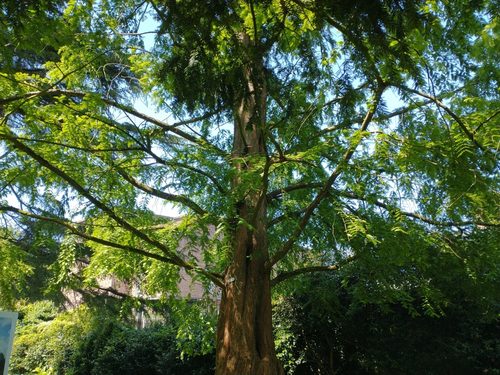
Dawn Redwood (Metasequoia glyptostroboides) · ~80 years · Queen's Quarter, Belfast
Until 1946 this species existed only as a fossil. Metasequoia was known from stone impressions and presumed extinct until living trees were found in China that year. Seed reached the Arnold Arboretum in Boston in 1948, and the seedlings raised from it were the first dawn redwoods sent out to botanic gardens around the world.
Belfast's came almost immediately. The Friends of Belfast Botanic Gardens date this specimen to about 1950, which makes it one of the first dawn redwoods grown in Ireland after the species came back. It carries tag number 59, and the Tree Council of Ireland's register lists it as a notable tree.
At roughly 76 years old it is young for a tree with a page here, and that is the interesting part: the whole cultivated stock outside China began with one sowing in Boston, and this is one of the first of those plants to reach the island. It is also a conifer that behaves like a broadleaf. The needles come through fresh green in spring, and in late October they turn rust orange and fall, the whole lot of them, which is not what a conifer is supposed to do.
Three dawn redwoods now grow in these gardens, which is a fair measure of how quickly a resurrected species can be made ordinary.
Photo: Brian Ó Maoláin (CC BY)
Common Hawthorn (Crataegus monogyna) · Stranmillis / Queen's Quarter, Belfast
Belfast's oldest Christian burial ground is named after this hawthorn. Under the Penal Laws of the eighteenth century, when the Mass was banned, Catholics gathered in secret beneath a thorn on this ground to hear it said. Belfast City Council and Northern Ireland's Remarkable Trees project tell it the same way, and the name stuck: Friar's Bush. The poet Joseph Campbell called it the Stranmillis trysting thorn. A darker version of the legend has a friar murdered and buried by the spot where he preached, with a stone laid over the grave.
The tree itself is low and undramatic, reclining rather than standing, in the middle of the graveyard. Nobody has dated it and nobody has put a tape round it. Remarkable Trees puts the impression well: it may well bow down under the weight of its history. If you know an age or a girth for it, tell us, because we do not.
Getting in takes a phone call. The graveyard is kept locked and Belfast City Council admits visitors on a booked slot, on 028 9027 0296 or by email, and guided tours run through Cairde na Cille and the Friends of Friar's Bush Graveyard. It costs nothing, there is no parking on site, and some paths are not passable in a wheelchair. Turning up unannounced gets you a look at the wall.
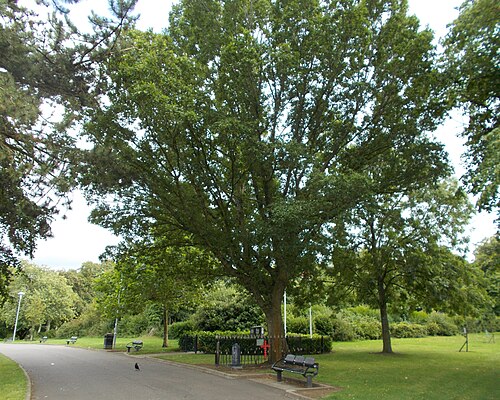
Pedunculate Oak (Quercus robur) · 105-110 years · Woodvale, Belfast
This oak was planted on Empire Day, 24 May 1919, for the men of Woodvale who did not come back from the First World War. For years it was where the veterans gathered. Then the veterans grew old, and the tree was forgotten.
It was rediscovered in 2006, the 90th anniversary of the Somme, and the council has since put a protective railing round it. In 2014 a European War Memorial was unveiled beside it, and that memorial remembers German, French, Belgian and British dead alike. A tree planted on Empire Day to honour one side now stands next to a monument to all of them, and it is hard to think of a better use for an oak.
In 2015 Northern Ireland voted it Tree of the Year, after the historian Bobby Foster and Sam Coulter nominated it, and at the 2016 European final it finished 13th with 628 votes.
Its age is not an estimate. Count from 1919 and it is a little over a hundred years old, young by the standards of oaks and old by the standards of anyone who remembers why it was planted. Nobody has recorded its girth or height, so if you measure it, tell us.
Photo: Whiteabbey (CC BY-SA 4.0)