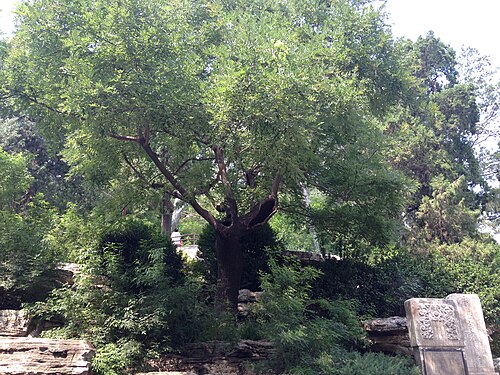
The Seven Liao Cypresses
Approximate location.
You need a ticket to see this treePaid entry to Zhongshan Park: 3 RMB (half price 1.5 RMB). Park hours: 6:00-21:00 (last entry 20:30) Apr-May and Sep-Oct; 6:00-22:00 (last entry 21:00) Jun-Aug; 6:30-20:00 (last entry 19:30) Nov-Mar. During the spring tulip season (early March to mid May) the ticket is 10 RMB (half price 5 RMB).
The altar came second. Seven cypresses stand outside the south gate of the Sheji Altar, and local tradition holds them to be survivors of the Liao-dynasty Xinguo Temple that occupied this ground before the Ming laid out the altar in 1420. That would put them past a thousand years. It is a temple-succession story rather than a dated planting, so read the figure as the tradition it is and not as a measurement. The thickest of the seven runs close to six metres round, which the local description puts at four adults with arms outstretched, only just meeting. Another divides into nine major limbs that then divide again, and the comparison people reach for is a thousand-armed Guanyin. The city keeps a file on each tree in the grove and monitors them individually; recent reporting describes all seven as thriving. A few steps away is the thing most visitors photograph: a scholar tree over two hundred years old growing out of a split in one of the cypresses, known locally as the cypress and scholar tree embrace. The ground is Zhongshan Park now, beside the Forbidden City, three yuan to enter. Ming and Qing emperors made their offerings for land and grain here. Our pin marks the park rather than the grove, because no source gives a coordinate for the trees themselves.
Outside the south gate of the Sheji Altar (社稷坛), Zhongshan Park, Dongcheng District, BeijingYou can recognise them by the scholar tree growing out of a split in one trunk, and by the thickest of the seven at close to six metres round. They stand outside the south gate of the Sheji Altar.
Tian'anmen West station, Line 1, short walk to the park's east gate
Sources
Where the facts on this page come from.