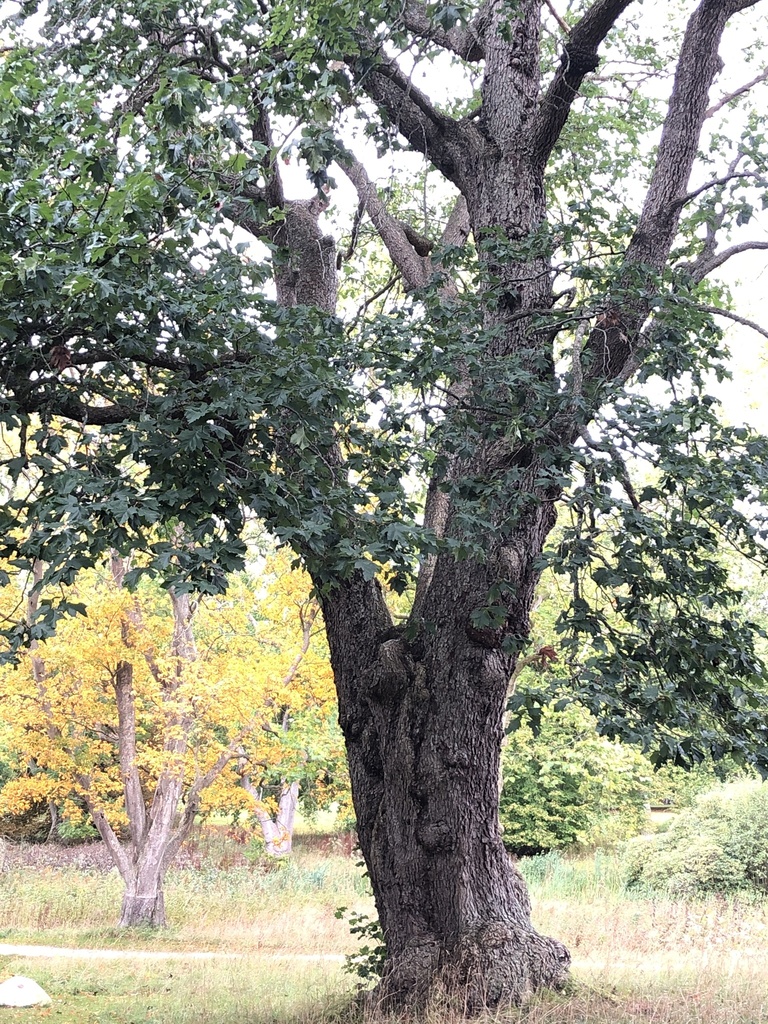
The Black Locust on Moesgård's Mound
A dead crown is not usually a reason to walk anywhere. This black locust has one, and it stands on a mound somebody built, which between them make it the strangest thing in the park. It is 4.98 metres around and 15.5 metres tall, and when the tree register surveyed it in March 2022 the verdict was alive but weak, with a large part of the crown dead and the tree weakened by age. Read that girth carefully. Black locust grows fast and thickens early, so five metres of trunk means far less here than the same figure would on an oak. The species is North American, brought to Europe in the early seventeenth century and named after Jean Robin, gardener to the French kings, and it arrived in Danish parks as an exotic with rot-proof timber and hanging white flowers in early summer. It also breaks. Brittle wood under a heavy crown is why old locusts end up looking like this one. The mound is man-made, the register says, though no source names who raised it or when. And that survey is four years old now, so a tree already shedding its crown then may have shed more since. Worth knowing before you go, and worth telling us what you find when you get there.
In bloom
June to July, when it flowers
The line is our estimate of how much there is to see, not a measurement. Typical for this species where this tree stands; exact weeks shift with the year.
Moesgård Museum park, on an artificial burial mound a few hundred metres east of the manor buildings, Højbjerg, AarhusYou can recognise it by its part-dead crown atop a man-made mound, weakened rather than merely old. It stands on the mound in Moesgård Museum park.
Free, in Moesgård's open park grounds (the museum building itself has paid entry; the surrounding park and forest are open to the public)
Bus line 18 from central Aarhus to Moesgaard Museum, roughly 27-30 minutes, then a short walk into the park
Sources
Where the facts on this page come from.
- In the official register: Dansk Træregister (Dansk Dendrologisk Forening)
- dendron.dk, detaljer
- dendron.dk, detaljer