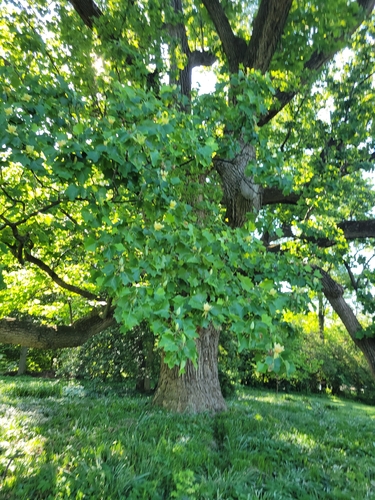
The Montrose Park Tulip Poplar
Georgetown
Two websites call this the second largest tree in Washington. Casey Trees, whose volunteers did the measuring, ranks it fifth. Their survey put it at 235 inches around and roughly 110 feet tall with a crown spreading about a hundred feet, behind two willow oaks and the chestnut oak out at Battery Kemble that holds a national co-championship. What both readings agree on is narrower and still worth the hill: no bigger tulip poplar has turned up in the District's surveys. Nobody has dated it. The Historic American Landscape Survey recorded it under its witness tree program, which is a heritage listing rather than a birth certificate, and neither that record nor Casey Trees puts a year on the tree. Tulip poplars rarely pass 250 years and a trunk this thick is not the work of a few decades, but any age you see attached to this tree, here or anywhere, is arithmetic from its girth rather than a measurement. It grows on the slope in the northwest corner of Montrose Park, where Lovers Lane starts dropping toward Dumbarton Oaks Park, so the beech grove walk begins more or less at its feet. No tree level coordinate is published anywhere, so the pin is the corner of the park and the last stretch is done by eye. At 235 inches around, that is not a hard search.
From people who stood here
No notes yet
Did you visit the tree? Leave a note for the next visitor.
Getting there
Montrose Park, R Street NW between 30th and 31st Street NW, Georgetown, Washington, DC 20007 (northwest corner of the park, on the slope near Lovers Lane, descending toward Dumbarton Oaks Park)
You can recognise it by the trunk, 235 inches round, under a crown about a hundred feet across. It stands on the slope in the northwest corner of Montrose Park, where Lovers Lane starts dropping toward Dumbarton Oaks Park.
Free, public NPS-adjacent city park, open daylight hours
Georgetown; no Metro station in the neighbourhood, roughly 20-25 min walk from Dupont Circle or Rosslyn Metro, or DC Circulator bus to Wisconsin Ave/M St then a 15 min walk uphill
In bloomAutumn colour
October, when a hundred feet of crown turns clear yellow over Lovers Lane
The line is our estimate of how much there is to see, not a measurement. Typical for this species where this tree stands; exact weeks shift with the year.
Sources
Where the facts on this page come from. The story was written with AI from these sources, and readers who know the tree correct it.