Shingu maps one tree: the Sacred Nagi of Kumano Hayatama Taisha, reportedly the largest tree of its kind in Japan and reputedly planted by a Heike-era samurai in 1159. It stands on the shrine's own approach path, inside a UNESCO World Heritage pilgrimage site. You can recognise it by the deep grooves running the length of its trunk, which read as several stems grown together. It stands on the approach path inside Kumano Hayatama Taisha.
0 of 1 visited in Shingu
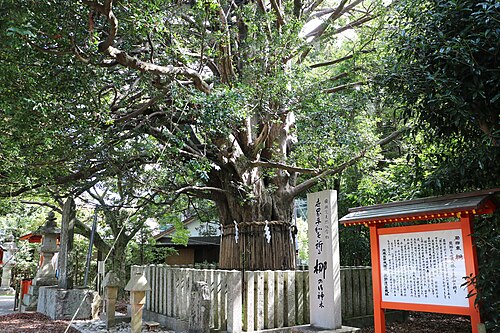
Nagi (Nageia nagi) · 1,000 years · Shingu, within Kumano Hayatama Taisha shrine grounds
A samurai on his way to put down a rebellion stopped here to pray, and the story says he planted this tree afterward with leaves taken from its own branches as a battle charm. That was 1159, according to the tradition attached to the Sacred Nagi of Kumano Hayatama Taisha, and whether or not Taira no Shigemori's hands were the ones that did it, the tree he is credited with has stood on this approach path ever since.
Nagi is Nageia nagi, a broad-leafed conifer unrelated to the pines and cedars that dominate most Japanese shrine grounds, and this is reportedly the largest example in the country: about 17.6 metres tall, its trunk running 4.45 metres round at chest height. Look closely and the trunk does not read as one clean cylinder. Grooves run the length of it, and from most angles it appears to be several stems grown together rather than a single trunk, all confirmed to be the same tree.
It stands inside Kumano Hayatama Taisha, one of the three grand shrines of Kumano Sanzan and part of the Kumano Kodo, the pilgrimage network that carries UNESCO World Heritage status across the Kii mountains. In 1972 a sapling grown from this tree was planted in Okinawa to mark the prefecture's return to Japan, a small, live continuation of a thousand-year-old tree rather than only a legend about one.
Free to see on the shrine's public approach, a short walk from Shingu station.
Photo: さかおり (CC BY-SA 4.0)