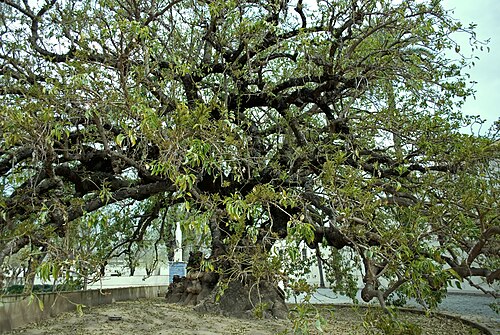
The Mulberry of the Alamillo Cortijo
This mulberry's trunk runs 4 metres round, unusually thick for a species more often kept small and heavily pruned for its leaves than left to grow into a full tree. Seville's 2022 survey found it physiologically stressed with a compromised structure, though still supported and standing, and rated its overall condition good despite both flags. It grows by the Cortijo, an old farmstead building preserved inside the Parque del Alamillo, the large public park built on the Isla de la Cartuja for Expo '92 around what had been the Duke of Alba's private hunting estate. White mulberry was planted across Spain for centuries to feed silkworms, an industry Seville itself once had a stake in, and a farmstead like the Cortijo would very plausibly have kept mulberries exactly like this one as a working crop tree rather than an ornamental. Every June the tree drops pale, sweet fruit that stains whatever pavement or grass sits beneath it, the same fruit that made the species worth planting in the first place, long before anyone valued it for shade.
In fruit
June, when the mulberries ripen and drop
The line is our estimate of how much there is to see, not a measurement. Typical for this species where this tree stands; exact weeks shift with the year.
Cortijo del Parque del Alamillo, 41007 SevillaYou can recognise it by the trunk, 4 metres round and unusually thick for a mulberry. It stands by the old Cortijo farmstead inside the Parque del Alamillo.
Free, public park
In the Parque del Alamillo, reachable by bus or bicycle from the city centre across the Puente del Alamillo.
Sources
Where the facts on this page come from.
- In the official register: Inventario de Arboles Singulares de la Ciudad de Sevilla (Ayuntamiento de Sevilla, 2022), no. ficha 26
- femas.es
- sevilla.org