At twenty-four metres, the Willow-Leaved Ash is the tallest of six trees in York Museum Gardens officially recognised as Yorkshire county champions, the largest recorded example of its kind anywher...
Ancient Trees in the York Museum Gardens
Ten acres of botanical garden laid over the ruins of a wrecked abbey, which is a strange thing to walk through and an excellent thing for trees.
The Yorkshire Philosophical Society made these gardens in the 1830s around the remains of St Mary's Abbey, dissolved by Henry VIII three centuries earlier, and planted them as a scientific collection rather than a lawn. Six of the trees we map stand here, all within a few minutes of each other, which makes this the tightest cluster in the city and one of the tightest anywhere on the site.
All 6 stand in York, which maps 6 remarkable trees in total.
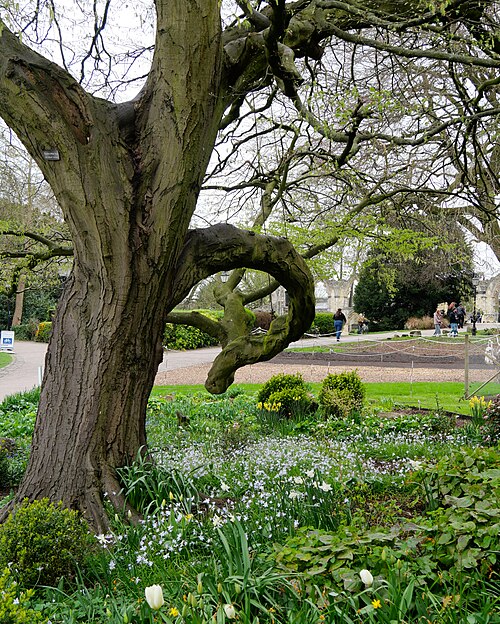
Photo: habiloid (CC BY-SA 2.0)
The Cut-Leaved Hornbeam's trunk is hollow, its canopy hangs low enough to brush the grass, and the whole tree curls into itself rather than growing straight up, more contorted shrub than the neat s...
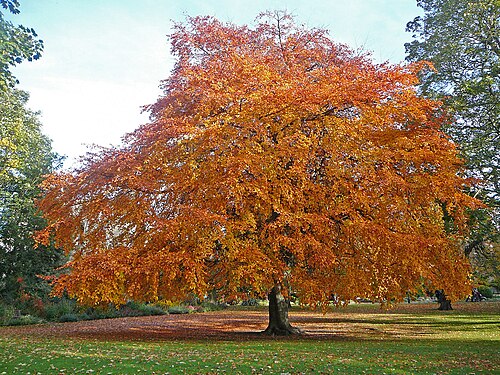
Photo: Tim Green (CC BY 2.0)
Halfway up the trunk of this beech, at almost exactly two metres, the bark changes: rough and fissured like a pear tree's below the line, smooth and grey like an ordinary beech's above it.
On the lawn closest to the River Ouse, the Cut-Leaved Alder produces small woody cones through the whole of winter and reddish-purple catkins every spring, and its leaves are cut so finely they rea...
Pyrus elaeagrifolia, the Elaeagnus-Leaved Pear, only reached Britain around 1844, imported from the eastern Mediterranean and Anatolia as a garden curiosity rather than a fruit tree, and York Museu...
Tilia cordata, the Small-Leaved Lime, is Britain's only native lime, and in the wild it all but disappears once you travel north of the Midlands, which makes the twenty-five metre example growing i...
Opening times and visitor information: York Museums Trust.
More parks worth the walk: every park we map. Or explore by city: Brussels · Pamplona · Lisbon · Barcelona · Oahu · Amsterdam