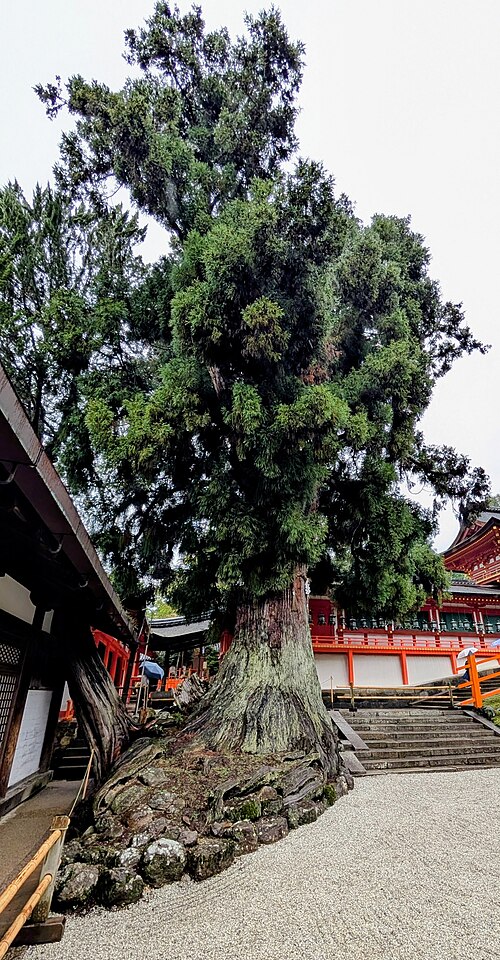
The Great Nagi of Kasuga Taisha
Kasugano
Approximate location.
This tree should not be here at all. Nagi grows wild in Kyushu and Taiwan, far to the south, and the nine hectares of it on this hillside are the northernmost stand of its kind, a national natural monument since 1923. Nara City's own record is blunt about why: the grove is not natural. Trees were offered to the shrine during the Nara period and the descendants of those offerings spread across the slope, so what looks like ancient woodland is the result of twelve centuries of donation. This individual is the largest of them, three and a third metres around and thirteen metres tall, which for a species this slow is why estimates run to five centuries and beyond. It is a conifer that has forgotten how to look like one: the leaves are broad, leathery ovals with parallel veins running end to end and no midrib at all, so people who know their trees stop, look again, and go and read the sign. The city protected the tree itself in 1997, along with a twenty metre square of ground around it.
From people who stood here
No notes yet
Did you visit the tree? Leave a note for the next visitor.
Getting there
Kasuga Taisha precinct, north of the Treasure Hall, 160 Kasugano-cho, Nara
You can recognise it by the leaves, broad leathery ovals with parallel veins and no midrib at all, on what is actually a conifer. It is the largest of the grove, north of the Treasure Hall.
Kasuga Taisha precinct; outer grounds free, check on arrival which zone this tree falls in
About 25 min walk from Kintetsu Nara, or bus to Kasuga Taisha Honden
Sources
Where the facts on this page come from. The story was written with AI from these sources, and readers who know the tree correct it.