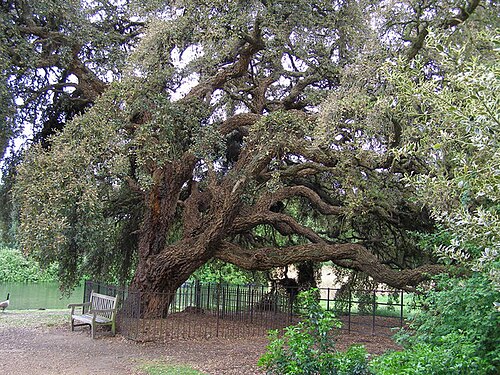
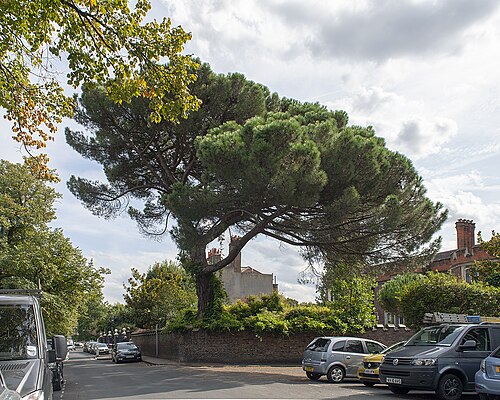
Every Whitsun, until about 1825, the people of Harlington turned out to clip their churchyard yew into shape, and made a festival of it. Through the 18th and early 19th centuries the tree was famous for its topiary, and a print of it sits in the British Museum's collection. Then the shears stopped, and the yew went back to being a yew. How old it is depends on whom you ask, and every answer is large. The church calls it at least 1,000 years old. A notice in 1914 said probably more than 1,000. The British Museum's record says over 900. None of those is a measurement, and old yews hollow out in a way that defeats ring counting, so the honest answer is a range rather than a number. The Ancient Yew Group measured it at 587 centimetres round at the ground and files it among the ancient trees. It stands opposite the south door of St Peter and St Paul, and the church's own history says it may mark the spot where Christianity was first preached here. That is tradition rather than record, but it is an old tradition attached to an old tree. The Ancient Yew Group also notes that Heathrow expansion plans could one day take the churchyard. For now it is free and open, about 1.5 kilometres from Hayes & Harlington station.
From people who stood here
No notes yet
Did you visit the tree? Leave a note for the next visitor.
Getting there
St Peter and St Paul churchyard, St Peter's Way, Harlington, Hayes UB3
You can recognise it by its size: the one great tree of the churchyard, 587 centimetres round at the ground. It stands opposite the south door of St Peter and St Paul.
Hayes & Harlington station (Elizabeth line, National Rail), about 1.5 km on foot; bus routes not source-checked.
In fruit
The line is our estimate of how much there is to see, not a measurement. Typical for this species where this tree stands; exact weeks shift with the year.
Sources
Where the facts on this page come from. The story was written with AI from these sources, and readers who know the tree correct it.