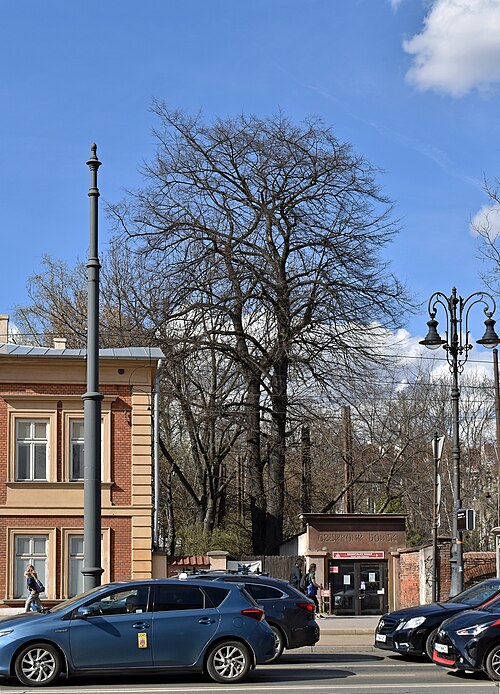
Three trunks rise from a single base on ul. Garncarska, and the number the register carries, 275 centimetres, belongs to the largest of them rather than to one trunk. The other two measure 203 and 175. Krakow listed the tree as a natural monument in 1968, decades earlier than most of the entries around it, which suggests somebody thought it unusual long before the modern register caught up. How old is it? Nobody knows, and here guessing would be worse than saying so. The girth-to-age arithmetic that dates the oaks and limes on this walk needs a growth factor calibrated to the species, and no reliable one exists for ginkgo: the tree thickens at wildly different rates depending on cultivar, site and how much room its roots were given. So the age field stays empty on purpose. If you have seen a planting record for this stretch of Garncarska, or a photograph old enough to help, tell us. What it does reliably deliver is November. Ginkgo leaves turn from green to a flat butter gold and then let go almost all at once, often within a couple of days, which on a three-stemmed tree of this size means a great deal of gold hitting the pavement in one go.
Autumn colour
November, when the crown turns butter gold and drops almost all at once
The line is our estimate of how much there is to see, not a measurement. Typical for this species where this tree stands; exact weeks shift with the year.
ul. Garncarska, KrakowYou can recognise it by the three trunks rising from one base, 275, 203 and 175 centimetres round. It stands on ul. Garncarska, on the edge of Planty.
Free, roadside tree on public ground (ul. Garncarska, bordering Planty), open at all hours
Teatr Bagatela tram stop or Krakow Glowny railway station, short walk
Sources
Where the facts on this page come from.
- In the official register: Centralny Rejestr Form Ochrony Przyrody (GDOŚ)
- pl.wikipedia.org
- crfop.gdos.gov.pl