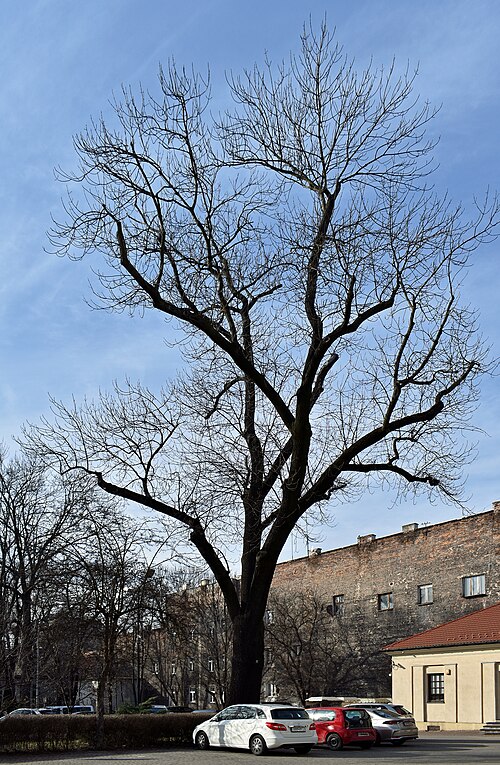
Nobody has measured this ginkgo's age, but its trunk gives away that it is old enough to fruit, a milestone the species does not reach for about forty years. It grows on ul. Franciszkanska beside the Church of the Franciscans in the Old Town, a two hundred and fifty eight centimetre trunk standing where monks have kept a garden for centuries. Poland's national register of natural monuments lists the tree's protection as dating from 1998; the city's own official list, reproduced on Polish Wikipedia, gives 1997 for this tree and several others nearby, a discrepancy that most likely traces to a province-wide reconfirmation regulation rather than a disagreement about the tree itself. Both dates are recorded here rather than picked between. Ginkgo biloba survived in cultivation around temple grounds in East Asia for centuries before European gardens took it up, and it tends to end up beside old religious buildings for the same reason it did here: nobody with authority over sacred ground had reason to cut down something that was simply doing well. No age has been established for this specimen. If you know one, tell us.
Autumn colour
November: the whole crown turns butter gold, then drops in a day or two
The line is our estimate of how much there is to see, not a measurement. Typical for this species where this tree stands; exact weeks shift with the year.
ul. Franciszkańska, Stare MiastoYou can recognise it by the trunk, 258 centimetres round, standing beside the Church of the Franciscans. It grows on ul. Franciszkanska in the Old Town, where monks have kept a garden for centuries.
Free. Stands on ul. Franciszkańska in the Old Town, beside the Church of the Franciscans (kościół oo. Franciszkanów); publicly visible and reachable from the street at all times.
Filharmonia tram stop, about 3 minutes' walk.
Sources
Where the facts on this page come from.
- In the official register: Centralny Rejestr Form Ochrony Przyrody (GDOŚ)
- crfop.gdos.gov.pl
- pl.wikipedia.org