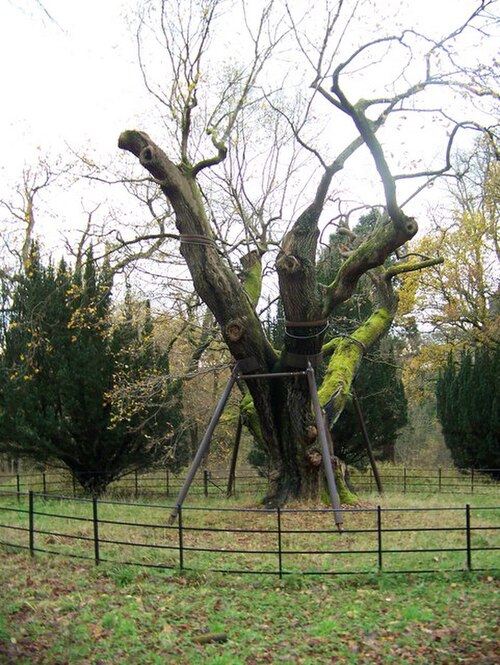
One of the oaks in this pasture has been dated to around 1440. Historic Environment Scotland, which lists the Chatelherault landscape in its inventory of designed landscapes, describes the Cadzow oaks as pollards so old they are difficult to date at all, and that one date is the firm point in the fog. Parks and Gardens UK repeats it. Most of the others are simply called ancient, and local captions say over 500 years. They are what remains of the Hamilton High Parks, the medieval hunting forest of Cadzow on the slopes near Cadzow Castle. The oaks are the reason the ground is a Site of Special Scientific Interest. They were pollarded, cut back at head height so they regrew above the reach of grazing animals, and they still stand singly in grazed pasture, which is about as close as Scotland gets to seeing a medieval park the way it was used. Not all of them made it. Historic Environment Scotland records trees lost to intensive farming in the 20th century. Which oak they are is less settled than you would think. One description of the site calls them pedunculate oaks, another sessile, so we list them as oak and would like to hear from anyone who has looked at the acorn stalks. Chatelherault Country Park is free and open all year. The oaks were still being recorded by naturalists in September 2026.
From people who stood here
No notes yet
Did you visit the tree? Leave a note for the next visitor.
Getting there
Cadzow oak pasture, Chatelherault Country Park, Ferniegair, Hamilton ML3 7UE
You can recognise them as the old pollarded oaks standing singly in open grazed pasture, not in the woodland. They stand on the slope near Cadzow Castle and its earthworks in Chatelherault Country Park.
Day trip from Glasgow to Hamilton. Train to Hamilton Central, then about 2 km by road to the park, so allow for a bus, a taxi or a longer walk.
Sources
Where the facts on this page come from. The story was written with AI from these sources, and readers who know the tree correct it.