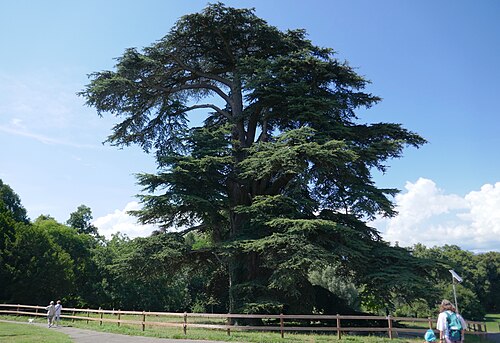
The Bald Cypress of Parc des Eaux-Vives
SwitzerlandGenevaEaux-Vives
Geneva's own lakeside walking guide files this tree under arbres insolites, unusual trees, and it earns the label every November by doing what no conifer is supposed to do. The bald cypress drops its needles. They go rust and copper first, the whole tree turning the colour of a beech, and then the branches stand bare all winter while the cedars around them stay green. Taxodium distichum comes from the swamp forests of the American southeast, where it grows with its feet in standing water and pushes woody knees up through the mud around the trunk. This one has drier ground and the lake a few metres off, a trunk 330 centimetres round, and a vitality rating of excellent, the top grade the register hands out. Nobody has dated it. The register carries a planting year of 1912, but that date falls on the first of January along with 21 other entries in the same file, which makes it an administrative default rather than a record. Judged on girth alone the tree is somewhere between one and one and a half centuries old, and that band is as tight as the evidence honestly allows. It stands on the city's signposted route between Parc La Grange and Parc des Eaux-Vives, which strings this and twenty other named trees into a single walk along the water.
Autumn colour
November, when the needles turn rust and fall, leaving the one bare conifer on Geneva's lakeside walk
The line is our estimate of how much there is to see, not a measurement. Typical for this species where this tree stands; exact weeks shift with the year.
Parc des Eaux-Vives, near Quai Gustave-AdorThe only conifer on this stretch that goes bare in winter and rust-coloured in November. It stands about 65 m from the stone pine.
Free, open park at any time
Bus or a 15-20 minute walk from the centre along the lakefront
Sources
Where the facts on this page come from.
- In the official register: Inventaire des arbres isolés (SITG, République et canton de Genève), no. 211415
- sitg.ge.ch
- geneve.ch