Fulufjället is a flat-topped mountain on the Norwegian border in northern Dalarna, a national park of bare fell, birch forest and Njupeskär, the tallest waterfall in Sweden. Trails climb from the visitor centre onto the plateau, where the ground is thin heath over rock and the weather turns fast. Somewhere up there, marked by nothing grand at all, stands a spruce whose root system has been alive since the ice retreated. It is a half-day walk and no part of it is a stroll.
0 of 1 visited in Fulufjället
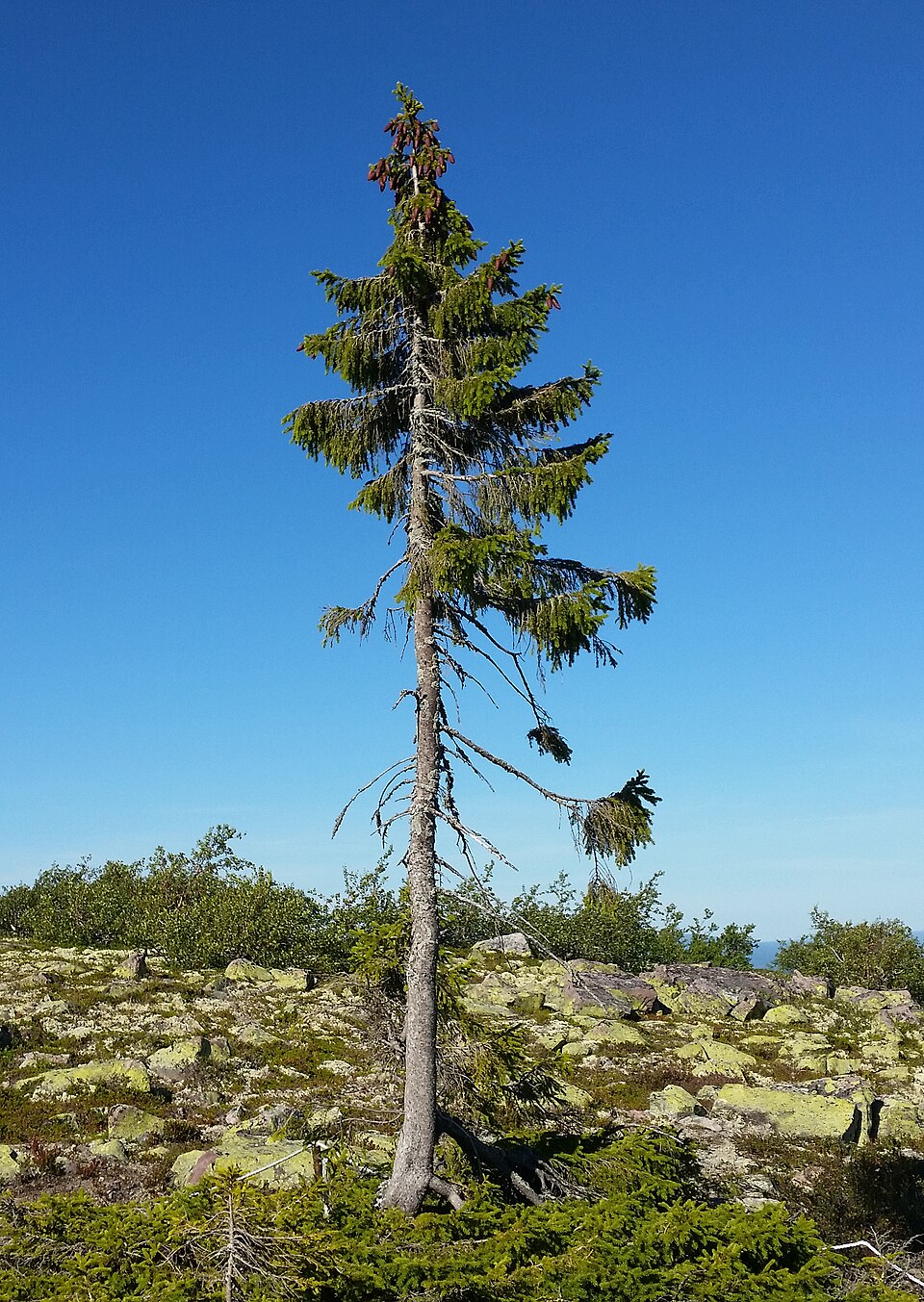
Norway Spruce (Picea abies) · 9550 years · Fulufjället mountain plateau, reached via the Njupeskär trail
Sweden's claim to the oldest tree in the world is a scrappy spruce about five metres tall, and the part you can see is only a few hundred years old. The 9,550 years belong to the root system underneath it. Carbon dating of material from the site returned ages of 375, 5,660, 9,000 and 9,550 years, work published by Umeå University in 2008.
The mechanism is worth understanding before you make the climb. A Norway spruce trunk up on this plateau lasts something like six centuries, then dies, and the roots send up a new one from the same genetic material. Layering rather than growth. So nothing about Old Tjikko is 9,550 years old the way an oak is 800 years old. What has persisted here since not long after the ice left Dalarna is the organism. The timber in front of you is the current edition.
It is still going. A winter storm in February 2023 snapped about a metre off its top, and that piece is now on display at the Naturum Fulufjället visitor centre at the bottom of the trail. In 2024 a Stockholm art studio grew a clone from twigs cut off its upper branches for an installation in Malmö.
Reaching it is a half-day. A marked trail climbs from the Njupeskär car park onto open fell, seven to nine kilometres round trip, under snow into early summer. No bus, no ticket, no guide. Stay on the markers: the mountain heath does not recover.
Photo: Karl Brodowsky (CC BY-SA 3.0)