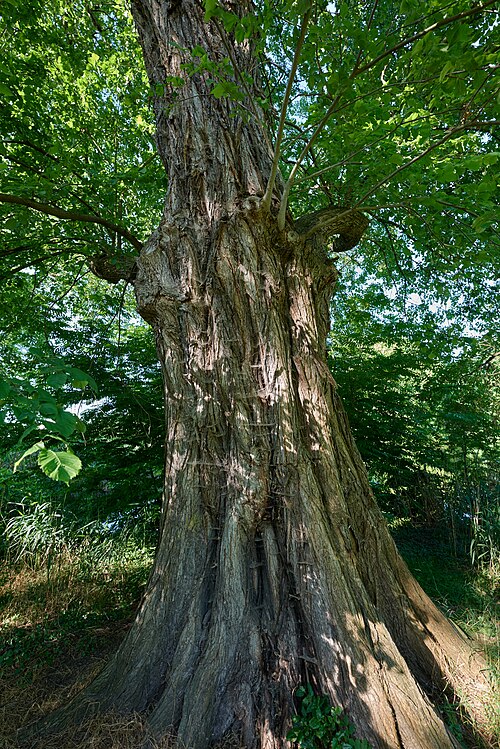
Botanists knew this tree as a fossil before anyone knew it was still alive. The dawn redwood was described from fossil remains in 1941, and only a few years later living trees turned up in central China. Seed went out to gardens around the world from 1948, which is how a species once thought extinct ended up in a park in Wedding. That history sets a ceiling on its age, if not a number. A dawn redwood in a Berlin park cannot predate that postwar seed, so this one is decades old rather than centuries, and its claim to a page is rarity and looks rather than years. Berlin agreed: it made the tree Naturdenkmal 1-44/B on 2 March 1993 for both, Schönheit and Seltenheit, beauty and rarity. It stands in the Volkspark Rehberge, opposite the entrance to the open-air stage, and it is a conifer that behaves like an oak. Its soft needles come out bright green in spring and turn a rusty orange-brown in autumn before they drop, leaving a bare, tapering frame all winter. It was photographed in leaf in June 2025. Berlin's register gives no planting date and no girth, and we have not found another source that does. If you know when it went in, or you have measured the trunk, tell us.
bright green needles turn a foxy reddish brown, then fall
late October into November, when the needles turn rust-orange before they fall
The line is our estimate of how much there is to see, not a measurement. Typical for this species where this tree stands; exact weeks shift with the year.
Volkspark Rehberge, opposite the Freilichtbuehne entrance, Berlin-Wedding You can recognise it in autumn by its needles turning rust-orange, and in winter by its bare branches, a conifer without needles. It stands opposite the entrance to the Freilichtbühne, the open-air stage.
Free, public park (Volkspark Rehberge), open at all times.
U6 Afrikanische Strasse, about 8 minutes on foot (approximate).
Sources
Where the facts on this page come from.