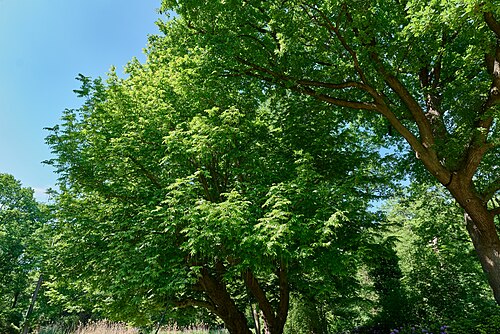
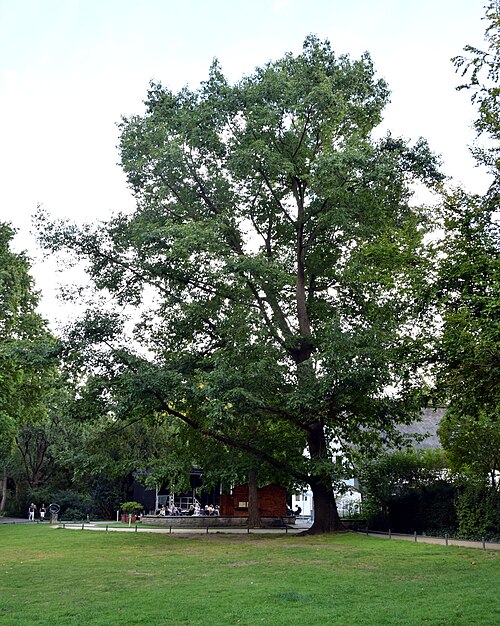
The Asia Minor Fontanesia of the Kleiner Tiergarten
Berlin protects this one because almost nobody else has one. The city's register names rarity first, and Fontanesia earns it: a quiet relative of the privet and the olive, native to Asia Minor and almost never planted in a German park. Most people crossing Moabit's Kleiner Tiergarten walk past it as just another shrub. That is the reason to look. It is not here for size, and the register makes no claim that it is. It was made a Naturdenkmal on 2 March 1993 for two reasons, rarity and what Berlin calls landeskundliche Gründe, local-history grounds, a phrase the city uses for trees that tell you something about the place they stand in. The register does not spell out what that something is here, and we will not guess. There are two of them. Berlin lists them separately, as 1-49 and 1-50, about 25 metres apart on the east side of Stromstrasse, and a visitor sees them as a pair, so we treat them as one stop. Both were photographed in leaf in June 2024, which is the best evidence we have that they are still doing well. What nobody has recorded is how old they are or how big. Berlin's register carries neither age nor girth, and no other source we found fills the gap. If you know when these were planted, or you have stood beside them with a tape measure, tell us.
Kleiner Tiergarten, east of Stromstrasse, Berlin-Moabit You can recognise it by its narrow, privet-like leaves on a shrub-sized tree. It stands east of Stromstrasse with its twin, listed as 1-50, about 25 metres further east.
Free, public park (Kleiner Tiergarten), open at all times.
U9 Turmstrasse, about 6 minutes on foot (approximate).
Sources
Where the facts on this page come from.