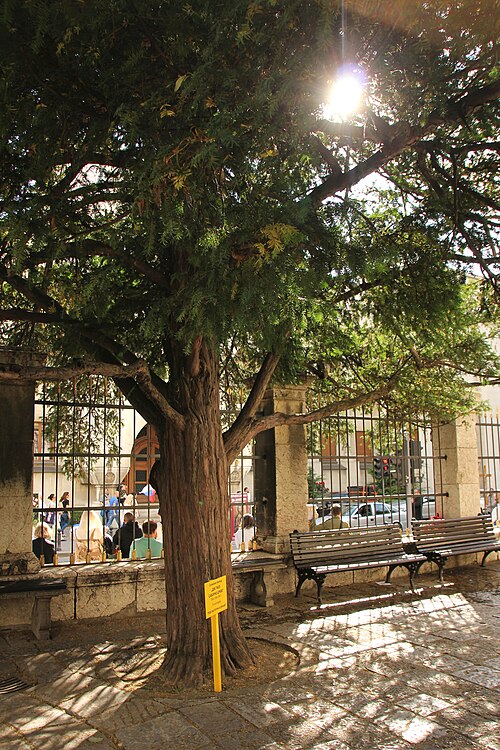
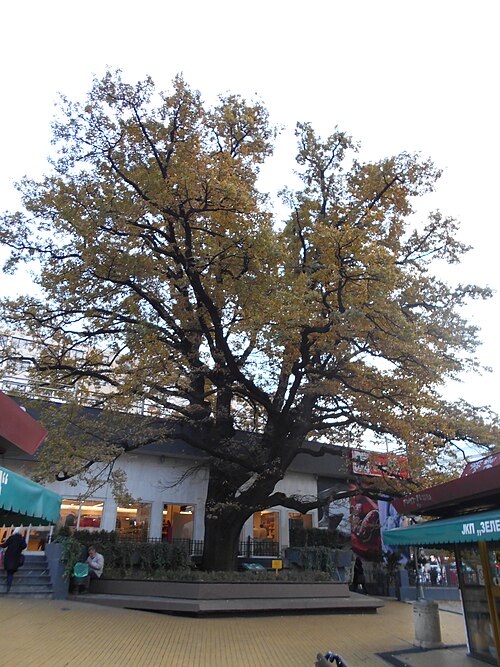
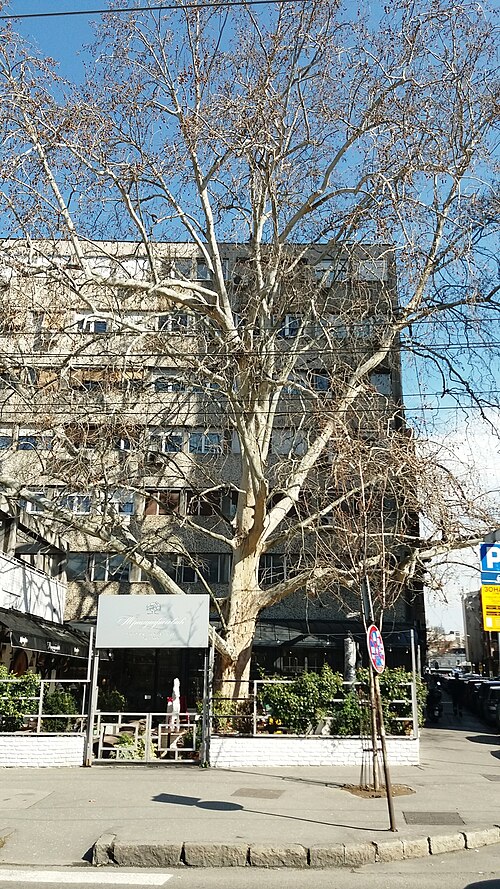
Zemun's Gradski park protects nine trees as a single natural monument, not one, an unusual designation that covers five European yews and four groups of Caucasian wingnut scattered through a park most Belgraders think of simply as Zemun's green center. All are roughly 110 years old, planted around the turn of the 20th century when Zemun was still an Austro-Hungarian town across the river from the Kingdom of Serbia rather than the Belgrade municipality it later became. Caucasian wingnut, a fast growing riverside tree from the Caucasus and northern Iran, is rare enough in Serbian parks that finding four separate stands of it in one place justified protecting the whole grouping in 1991 rather than picking out a single champion specimen. The yews do the more familiar work, dark, dense evergreen shapes among the park's roughly 1,300 other trees, old enough and large enough to count as genuine heritage rather than ordinary planting. Nothing here has a named legend attached, no prince, no botanist, no famous visitor, just a formal designation covering an entire pocket of a park that has quietly outlasted the empire it was planted under.
From people who stood here
No notes yet
Did you visit the tree? Leave a note for the next visitor.
Getting there
Gradski park (City Park), Zemun, Belgrade
You can recognise them as dark, dense evergreens among nine trees protected as one designation, five yews and four wingnut stands. They stand scattered through Zemun's Gradski park.
Zemun, on the Danube waterfront; about a 25 minute bus ride from central Belgrade
In fruit
red arils on female trees, the only part that is not poisonous
The line is our estimate of how much there is to see, not a measurement. Typical for this species where this tree stands; exact weeks shift with the year.
Sources
Where the facts on this page come from. The story was written with AI from these sources, and readers who know the tree correct it.