Puglia's regional register recognises five trees in and around Bari as officially monumental, and this list carries all five. Two share a flowerbed in the gardens of Piazza Umberto I: an Argentine ombu too heavy for its own roots, and a Mexican ponytail palm locals call the smoke-eater. A third, a scarred Aleppo pine in Carrassi, has been climbed by neighbourhood kids for decades. Two more stand out in Toritto, a Murgia hamlet 30 minutes away: the Lie Tree of Quasano, and a downy oak inside a working farm reached only by booking a walk.
0 of 5 visited in Bari
Ombu (Phytolacca dioica) · 70 years · Murattiano (Piazza Umberto I gardens)
Saving one of Bari's four officially monumental trees has been costed at around a thousand euros, and the money has not been spent. The tree is an ombu, it stands in the gardens of Piazza Umberto I five minutes from the central station, and it leans. It leans because it has spent years reaching for light past the holm oaks around it, and because the asphalt laid up to its base has damaged the plate of roots underneath. A local civic association put all of that in a letter to the mayor asking for a modest repair job.
The species is stranger than the tree looks. Phytolacca dioica is not a tree in the botanical sense but an outsized herb from the South American pampas, its trunk swollen with water storing tissue rather than timber, which is why nobody can date one by counting rings. Italy imported it in the middle of the 19th century as an ornamental curiosity, and almost none of those imports ever reached this size. This one is 2.5 metres around and about six metres tall, low and heavy and grey, and both the Puglia and the national registers list it as monumental on those measurements.
Its age is a guess by its own defenders, whose letter says it was probably planted in the 1950s. Nobody has put a firmer date on it. If you know one, tell us.
Ponytail Palm / Elephant's Foot (Nolina longifolia) · Murattiano (Piazza Umberto I gardens)
Bari calls this one la mangiafumo, the smoke-eater, on the local conviction that it swallows the traffic fumes of the streets around it. That part is folklore. What is not folklore is the base: three metres around, swollen into a grey elephantine foot that stores water, sitting in a public garden two minutes from the central station.
Nolina longifolia is a Mexican plant from dry limestone slopes at altitude, and the specimens Europe planted as ornamental curiosities in its gardens almost all stayed modest. This one did not. Three metres of girth under four and a half metres of height was enough for the Puglia and the national registers to list it as a monumental tree, one of only four in the whole of Bari and one of 74 in the region. A second of those four, the ombu, stands a few metres away in the same bed, so a visitor can see half of the city's officially remarkable trees without turning around.
The gardens around it were made by merging two 19th-century ones and rebuilt in 1905 around the equestrian statue of Umberto I. The mangiafumo's own arrival went unrecorded. It lays down no countable rings and no planting date has surfaced, so it comes to this page without even a range. If you know when it went in, tell us.
Aleppo Pine (Pinus halepensis) · 150 years · Carrassi
A branch on this Aleppo pine broke off in a heavy snowfall about two decades ago, and Bari's foresters simply cut the stump flush and left the rest standing, close to six metres round at the trunk. It grows in a fenced bed on a street corner in Carrassi, behind a low concrete wall low enough that generations of neighbourhood kids have climbed over it and up the tree itself, which the local paper reports as an open secret rather than a problem anyone has stopped.
The tree is one of only four in the whole of Bari that Puglia's monumental register recognises, though even the record argues with itself about what it is: the official listing calls it an Aleppo pine, a separate botanical survey calls the same tree a stone pine, and nobody has resolved which. A University of Bari botanist puts its age at roughly a century and a half, the same estimate he gives for a second monumental tree across town, while warning in the same breath that dating either one precisely is close to impossible.
Do not confuse it with the pine that stood one intersection further along the same street and was felled in 2025. This one, at the De Gasperi corner with Via Ugo La Malfa, is still there.
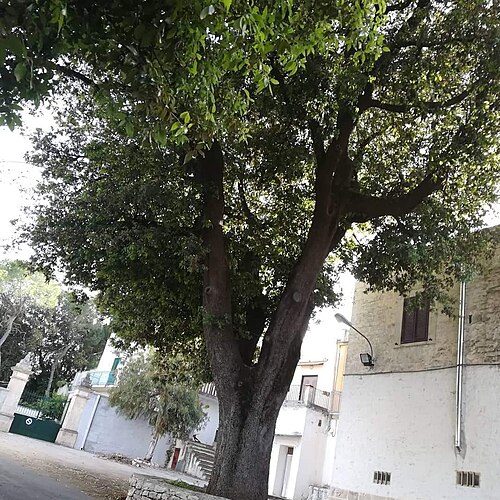
Holm Oak (Quercus ilex) · 125-175 years · Quasano, a hamlet of Toritto
Quasano calls its holm oak the Lie Tree. The name is a leftover complaint: after Italian unification, peasants gathered under its crown to trade grievances about promises the Garibaldian patriots had made and never kept, and the bitterness became the tree's name. Nobody recorded a planting date, but its absence from the estate's own land records before the mid-1800s land divisions is the closest thing to a birth certificate it has, putting it at somewhere over a century and a half old.
It stands exactly where it would have overheard those complaints, right in front of the gate of Quasano's old baronial masseria, positioned so awkwardly that carts once had to work around it to get through. A small chapel, later folded into a university building, faces it from across the way. At 3.2 metres round and 11 metres tall, it earned a place on Puglia's register of monumental trees in 2021, protected under the national law for trees of exceptional age, size or history. Italians have nominated it to the FAI's Places of the Heart campaign seven times since 2006, an unusually long streak of affection for a tree named after lying.
The gate it blocks now leads to nothing grander than divided smallholdings, the old estate broken up long ago. The tree outlasted the arrangement it complained about.
Photo: Mara Cavalluzzi (CC BY-SA 4.0)
Downy Oak (Quercus pubescens) · Toritto, a hamlet roughly 18 km from central Bari
The Roverella of Pilapalucci grows inside the walls of a working farm, which means nobody wanders up to it by accident. Masseria Storica Pilapalucci is a fortified farmstead dating to the 16th century, listed among Italy's historic private houses, and this downy oak stands in its olive and almond groves rather than beside a public road. The masseria opens its gates for scheduled events, among them a guided walk through the groves that stops at the tree it calls its own monumental specimen, which is how an outsider gets to stand under it at all.
Downy oak is the working oak of the Murgia plateau, built for thin limestone soil and dry summers rather than for spectacle, and this one has done the ordinary thing for a very long time: a trunk just over three metres round, a crown reaching twenty metres up. Nobody wrote down when it was planted. Centuries of farm labour around a masseria rarely leave that kind of note, and the regional register that protects it records size and species, never a birth date.
The visit is real, just conditional. Check the masseria's own event calendar before making the drive out to Toritto, and go on a day it is actually open.