Aruba maps one tree so far, the wind-bent fofoti on Eagle Beach that the island's tourism authority calls its most photographed. It is not known to be old; it is here for its shape, a trunk twisted by the trade winds and leaning toward the sea. It stands on the public sand in front of the Amsterdam Manor resort, free to see.
0 of 1 visited in ArubaSee your full collection
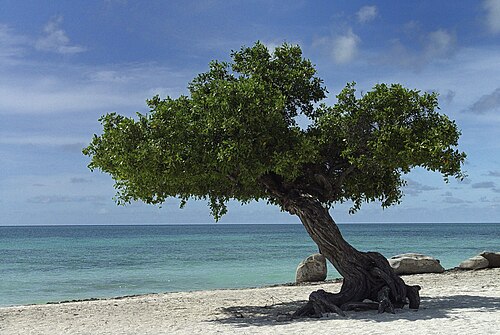
Button Mangrove (Conocarpus erectus) · Eagle Beach
This is not an old tree, as far as anyone knows. It is on this map for its shape. Aruba's tourism authority calls it the island's most photographed fofoti, and once you have seen it you understand why. The trunk twists out of the white sand, bends hard toward the sea and holds a flat green crown over the beach like a hand.
The wind did that. The trade winds blow across Aruba from the east nearly all year, and the Amsterdam Manor resort, whose stretch of Eagle Beach the tree stands on, says they have pushed the trunk toward the water over its whole life. Fofoti trees are protected under Aruban law, the resort says, and in 2021 this one appeared on an Aruban stamp.
Half the photographs online call it a divi-divi. It is not. The divi-divi is a different tree altogether, the one Curaçao counts as its national tree. The fofoti is a button mangrove, Conocarpus erectus, a relative of the true mangroves that grows happily with its roots in salty ground.
Eagle Beach has more than one of these trees, so the pin marks the one in front of the resort, the one in the photograph. If you have stood under it lately, tell us it is still there.
Photo: Serge Melki (CC BY 2.0)