Seasons1 of 4
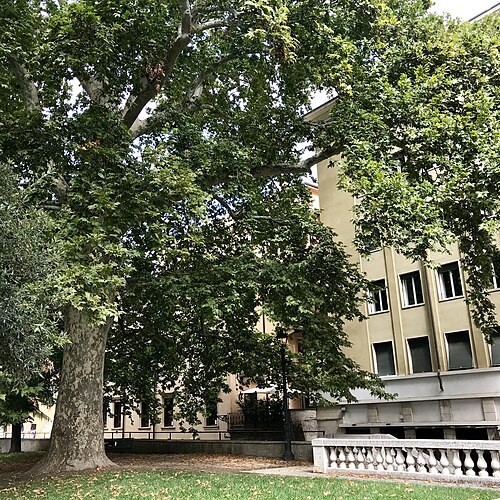
Verona's official monumental-tree register lists this ginkgo as a group rather than a single trunk, an average circumference of 323cm and average height of 23.5 metres across the specimens growing together in Piazza Indipendenza, sharing the same small garden as the square's much taller plane tree. Ginkgo biloba is a genuine living relic, the last surviving member of a family of trees that covered much of the planet before flowering plants existed, all descended from populations that survived in a handful of sheltered valleys in southeast China while the species vanished everywhere else. This grouping's precise age is not documented, though its inclusion on Italy's national monumental register confirms it as long-established rather than a recent planting. The city chose this square specifically to launch a public tree-history project in 2018, scanning trees with QR codes to tell their stories, evidence that this ginkgo and its plane tree neighbour are treated locally as some of Verona's most significant living landmarks, official register or not.
From people who stood here
No notes yet
Did you visit the tree? Leave a note for the next visitor.
Getting there
Piazza Indipendenza, 37121 Verona
You can recognise it as the group of ginkgos sharing the small garden with the square's much taller plane tree. It stands in Piazza Indipendenza.
10 min walk from Piazza delle Erbe
Autumn colour
November, when its fan-shaped leaves turn gold
The line is our estimate of how much there is to see, not a measurement. Typical for this species where this tree stands; exact weeks shift with the year.
Sources
Where the facts on this page come from. The story was written with AI from these sources, and readers who know the tree correct it.
- In the official register: Elenco degli alberi monumentali d'Italia (MASAF), no. 01/L781/VR/05
- veronanews.net
- commons.wikimedia.org
- masaf.gov.it