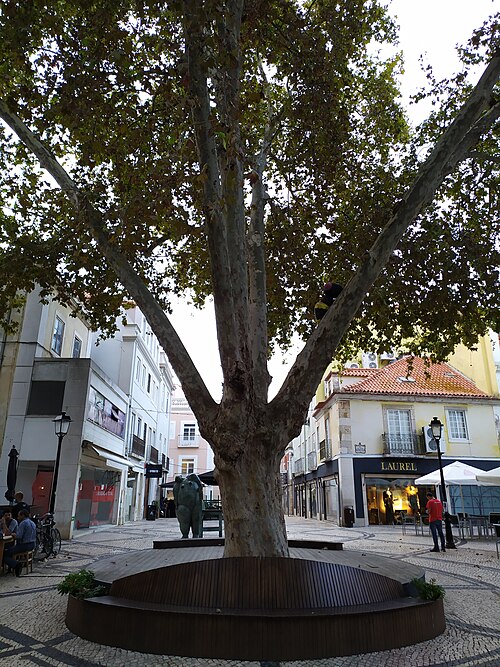
Six trees stand in a ring around one old circular stone tank with a fountain at its middle, and at twenty-six metres they are the tallest classified trees in the city. They were planted around 1919, which means they have watched the square change names three times and change purpose twice. It began as the Passeio do Lago, named for a garden with a lake at its centre. In January 1911 it became the Parque das Escolas, after two primary schools opened on it, one for boys and one for girls, so the young trees spent their first decades in a schoolyard. Through the 1930s the square held two open-air cinemas, one of them run by the volunteer fire brigade and the other called the Cine Parque, and films were projected under these branches on summer evenings. The name it carries now arrived in 1988, for Jose Afonso, whose song Grandola, Vila Morena was the radio signal that launched the revolution of 1974, and Grandola is in this district. The trees are evergreen, so they look the same in January as in July.
From people who stood here
No notes yet
Did you visit the tree? Leave a note for the next visitor.
Getting there
Largo Jose Afonso, 2900 Setubal
You can recognise them by the ring of six trees around the old circular stone tank and fountain, the tallest classified trees in the city. They stand in Largo Jose Afonso.
In the centre of Setubal, a few minutes on foot from the station
Sources
Where the facts on this page come from. The story was written with AI from these sources, and readers who know the tree correct it.
- In the official register: Arvoredo de Interesse Público (ICNF), no. KNJ3/065
- si.icnf.pt
- uf-setubal.pt, 377 roteiro das arvores de interesse pu…
- uf-setubal.pt, 1159 o largo jose afonso
- ICNF, Arvoredo de Interesse Publico (Portugal's national register of trees of public interest), no. KNJ3/065