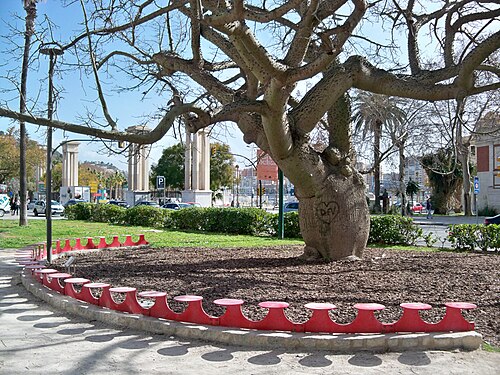
The Ficus Avenue of the Alameda Principal
Centro Historico
Approximate location.
Malaga's central promenade has had three different trees in its 240-year history, and the ones standing today were themselves meant to be temporary. The Alameda was laid out in 1783 with white poplars, which gave the street its name (alameda meaning poplar grove), later replaced with orange trees and oleanders. Those in turn came out in 1876, when architect Joaquin Rucoba's renovation brought in large-format ficus from India, Ficus microcarpa, known locally as laurel de indias. Nobody expected the imports to become the defining feature of the street, but 150 years on, their broad, wind-flattened canopies form a continuous green roof over the traffic below, dense enough that Malaguenos still call the shade underneath one of the coolest places in the city centre in August. Twenty-three of the original mature specimens survive today alongside younger replacements, and when Malaga built a metro line beneath the Alameda in 2018 and 2019, the works were designed specifically to protect their roots, removing traffic lanes rather than digging near the trunks. It remains one of the few 19th century streetscapes in Spain where the accidental choice, not the planned one, is the thing everyone remembers.
From people who stood here
No notes yet
Did you visit the tree? Leave a note for the next visitor.
Getting there
Alameda Principal, 29001 Malaga
Not one tree but the avenue itself, 23 of the original mature figs still standing among younger replacements down the middle of the promenade.
Malaga Centro-Alameda tram/metro station, or 5 min walk from Plaza de la Marina
Sources
Where the facts on this page come from. The story was written with AI from these sources, and readers who know the tree correct it.