Yubuta no Mori, the Bathing Camphor
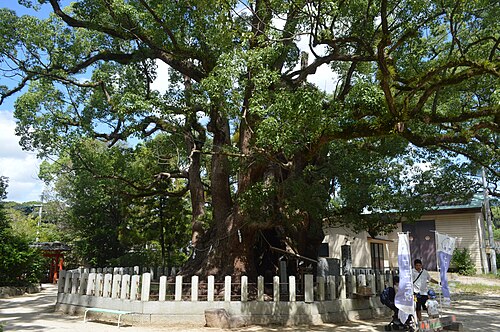
Its name means the bathing lid, and the legend explains the shape. Empress Jingu is said to have given birth to the future Emperor Ojin at this spot and to have bathed the newborn beneath this camphor, whose branches closed over the bath like a cover. The shrine that grew up around the story is now the principal shrine in Japan for safe childbirth, and expectant mothers travel from across the country to it. The tree is a single organism despite the word forest in its name, roughly fifteen metres around and reaching thirty metres, protected as a national natural monument since the eighth of March 1922. Sources put it at either a thousand years or two thousand, with no way to choose between them, so both stand here. What is not in doubt is its health: photographed in September 2024 it carries a full, dense, unbroken crown, which is more than can be said for several famous camphors nearer the city. Its equally protected companion stands about a hundred metres away and was designated on the same day.
From people who stood here
No notes yet
Did you visit the tree? Leave a note for the next visitor.
Getting there
Umi Hachimangu, 1-1-1 Umi, Umi town, Kasuya district 811-2101
You can recognise it by its full, dense, unbroken crown, about 15 metres round and 30 metres tall, a single trunk despite its name. It stands at Umi Hachimangu, about 100 metres from its companion camphor.
About 45 min from Hakata: JR to Kashii, then the Kashii line to Umi terminus, then 9 min walk
Sources
Where the facts on this page come from. The story was written with AI from these sources, and readers who know the tree correct it.
- In the official register: 国指定天然記念物 湯蓋の森・衣掛の森 (Agency for Cultural Affairs)
- town.umi.lg.jp
- ja.wikipedia.org
- online.bunka.go.jp