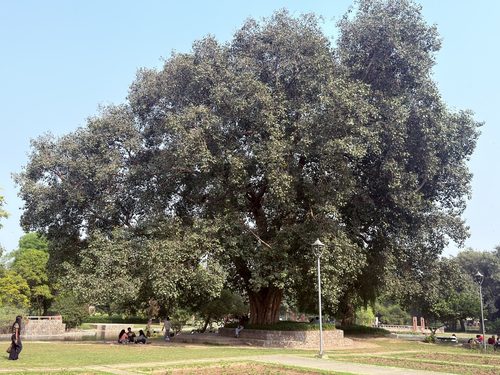
A reader sent us this banyan from a garden of lawns and paths a few minutes' walk from Humayun's Tomb in Delhi, and named it an Indian Banyan. A banyan, Ficus benghalensis, is India's national tree, and it grows in a way no other tree does. Its branches let down thin roots that hang in the air until they reach the soil, then thicken into new trunks, so an old banyan slowly turns into a grove that is still one tree. This one is well on its way. In the reader's photograph the trunk is not one stem but a bundle of pale roots grown into pillars, and the long limbs reach out sideways far over the paths, the broad leathery leaves hanging thick enough to shade everyone walking below. Behind it stands an old building of white cusped arches set in red walls, Mughal in style, so close that the banyan seems to lean against its arcade. People stroll the paths and sit on the grass under the outer branches. We do not know its age, its girth or who planted it. If you know this tree, tell us here and we will add what you know. It stands about 300 metres from The Peepal on the Plinth, our other Delhi tree, so the two make a short walk.
From people who stood here
No notes yet
Did you visit the tree? Leave a note for the next visitor.
Getting there
Garden near Humayun's Tomb, Nizamuddin, New Delhi
A wide banyan beside a Mughal pavilion of white cusped arches on red walls: its trunk is a bundle of pale hanging roots grown into pillars, with a round bed of ground cover at its foot.
In a landscaped garden where people walk the paths and sit on the lawns; the reader walked up to it. We have not confirmed the garden's opening hours or whether it charges entry; check before you go.