The Female Ginkgo of the Sot de la Masia
Montjuic, Sants-Montjuic
Approximate location.
Seasons2 of 4
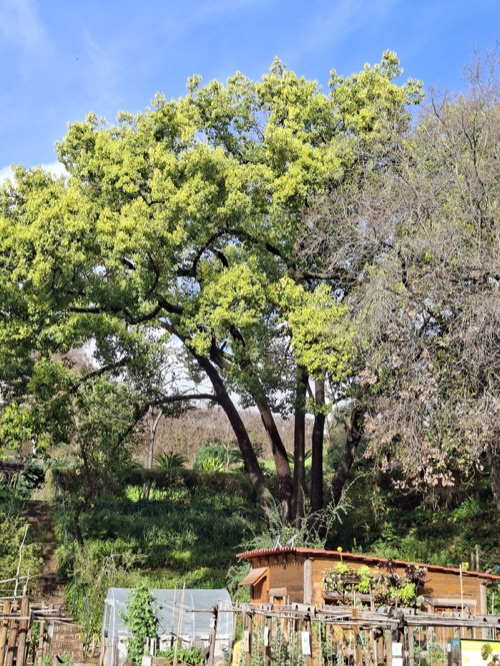
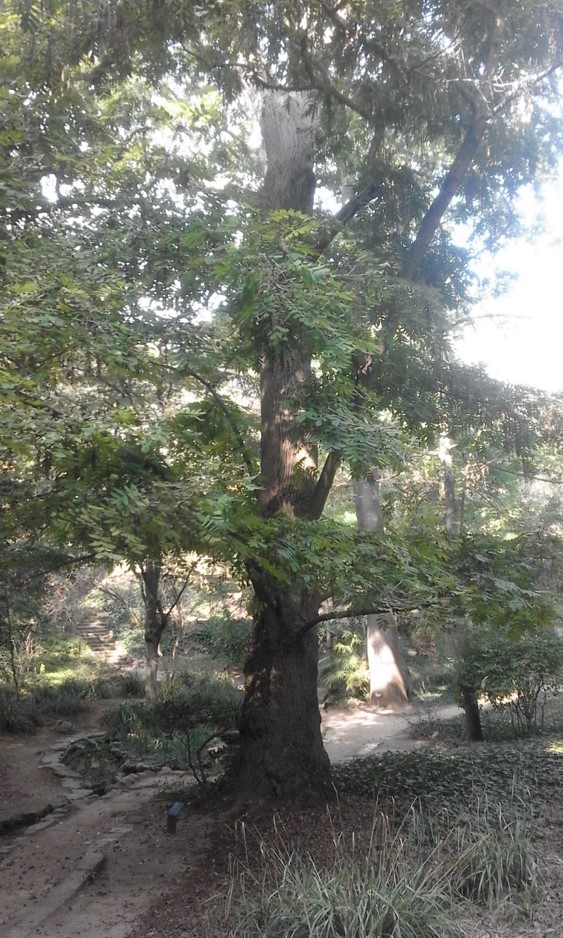
The historic botanical garden on Montjuic has three ginkgos, and this is the one that fruits. The two males stand down in the Sot de l'Estany; the female holds the central terrace of the Sot de la Masia, the second quarry pit, above the vegetable garden and a short climb from the big camphor tree. The garden's 2009 guide calls it a magnificent specimen and notes that it produces edible seeds, which is a polite way of saying that in autumn it drops fleshy fruit that smells of rancid butter, the reason most cities plant only males. The friends' association put it at about 70 years old and 12.5 metres in 2017, so it went in around the 1940s, when Antoni de Bolos was adding collections to a garden Pius Font i Quer had begun in 1930. Ginkgo is older than the dinosaurs that walked under it and survives today in the wild only in China, so a seed-bearing tree in a Barcelona quarry is a small outpost of a species that nearly did not make it. The best moment is the second half of November, when the whole crown goes gold at once against the dark hillside and then lets go within a week, carpeting the beds below. The farmhouse under the terrace was built as a model farm for the 1929 exhibition; the tree is younger than it.
From people who stood here
No notes yet
Did you visit the tree? Leave a note for the next visitor.
Getting there
Jardi Botanic Historic, Sot de la Masia, Av. dels Muntanyans, 08038 Barcelona
You can recognise it by the fan-shaped leaves, gold in November, on a tree about 12 metres tall standing on the central terrace of the Sot de la Masia directly above the vegetable beds, uphill from the big camphor tree.
Free entry, open daily: Nov to Jan 10:00-17:00, Feb-Mar 10:00-18:00, Apr-May and Sep-Oct 10:00-19:00, Jun-Aug 10:00-20:00; no entry in the last half hour; closed 1 Jan, 1 May, 24 Jun and 25 Dec. The Amics del Jardí Botànic give a free guided walk of the garden on the first Sunday of every month at 12:00, by the association's own account.
Poble Sec (Metro L3) or bus to Estadi Olimpic, 12 min walk
Autumn colour
the second half of November, when the whole crown turns gold and then drops it within a week
The line is our estimate of how much there is to see, not a measurement. Typical for this species where this tree stands; exact weeks shift with the year.
Sources
Where the facts on this page come from. The story was written with AI from these sources, and readers who know the tree correct it.
- Associació Amics del Jardí Botànic, by mail 2026-11-02
- Jardí Botànic Històric, jardí amagat (Àrea Metropolitana de Barcelona, 2009) and Itinerari botànic del Jardí Botànic Històric (AMB, Jardí Botànic d…
- museuciencies.cat